









2026.04.17
Multilingual e-Learning for Foreign Employees|In-House Training Conducted in English, Chinese, and Vietnamese

-
Category
Recommended Articles
-
What is Vyond? Introducing the benefits of an animation video production tool that can be used for business.
-
[Animation Teaching Material Production] How to Create e-Learning Materials ②
-
How does Vyond differ from other animation production software? Comparison and recommendations
-
Can Vyond animations be used as teaching materials? Here are the benefits of using them in e-learning and training.
-
Let's create business animations with Vyond! An explanation of the reasons and benefits recommended for business, as well as challenges.
-
Vyond Go (AI Video Generation) Tips and Best Practices ① Vyond Go Setup Guidelines
-
Moodle Basic Course: What is Moodle?
-
[Moodle Basic Course] What can the e-learning management system Moodle do?
-
[Moodle Basic Course] What can be done with Moodle's default features
-
Benefits and Considerations of Moodle Cloud Services
-
Moodle is not only used by universities (widespread use)



With the increase in foreign employees,
We want to make e-learning multilingual
We want to offer in-house training in English and Chinese versions
We want to conduct harassment training and information security training for foreign employees under the same standards
We are receiving more inquiries like these.
This article explains how to multilingualize training for foreign employees, supported languages, and the benefits of implementation.
Table of Contents
1. Background of Multilingual Support for e-Learning for Foreign Employees
2. Challenges Companies Face in Training Foreign Employees
3. What Is Multilingual e-Learning?
4. Examples of Supported Languages | English, Chinese, Vietnamese, etc.
5. Training Topics Suitable for Multilingual Implementation
6. Benefits of Multilingual e-Learning
6-1. Standardizing Comprehension Criteria
6-2. Streamlining Education Management
6-3. Compliance with Audits and Internal Controls
7. Implementation Image (Assumed Case)
8. Frequently Asked Questions (FAQ)
8-1. Which Languages Are in High Demand for e-Learning for Foreign Employees?
8-2. How Can e-Learning Be Multilingualized?
8-3. Which Training Should Be Multilingualized First?
9. Summary
1. Background of Multilingual Support for e-Learning for Foreign Employees
With the increase in foreign employees,
We want to make e-learning multilingual
We want to offer in-house training in English and Chinese versions
We want to conduct harassment training and information security training for foreign employees under the same standards
We are receiving more inquiries like these.
This article explains how to multilingualize training for foreign employees, the supported languages, and the benefits of implementation.
2. Challenges Companies Face with Training for Foreign Employees
While the hiring of foreign employees is increasing, there are also many companies that feel challenges in managing internal training.
HR and training personnel often hear the following comments:
・There is concern about whether the content is fully understood in Japanese-language training
・Time is needed for individual explanations after the training
・There are variations in test results
・It is unclear whether the standards for harassment and compliance are being adequately communicated
In particular, themes such as harassment prevention, information security, and personal data protection are crucial training topics directly linked to corporate risk management.
Therefore, it is required that employees understand these topics by the same standards regardless of their nationality or language.
However, when training is provided only in Japanese, the "language" itself can become a barrier to understanding, rather than the content.
Against this backdrop, in recent years, the number of companies offering the same training content to foreign employees by making e-learning multilingual has been increasing.
3. What is Multilingual e-Learning?
Multilingual e-learning means,
translating existing Japanese training content into English, Chinese, Vietnamese, and other languages, and providing the same content in multiple languages.
What is important is not just translating,
・Common instructional structure
・Common learning objectives
・Common test content
By doing so, the understanding standards of all employees are aligned.
4. Examples of Supported Languages|English, Chinese, Vietnamese, etc.
In multilingual support for training aimed at foreign employees, there tends to be high demand for the following languages.
・English
・Chinese (Simplified and Traditional)
・Vietnamese
・Indonesian
・Thai
・Spanish
・Korean
It is common to select and deploy the necessary languages according to the company's employee composition and industry.
Instead of localizing all training materials into multiple languages,
・Only mandatory training is multilingualized
・Start with the English version
・Support only for specific departments
Many companies also adopt a phased implementation approach.
* In addition to the languages listed above, Human Science supports more than 50 languages.
Please feel free to contact us.
5. Training Themes That Are Easier to Consider for Multilingualization
The highest priority is compliance training required for all employees.
・Harassment Prevention Training
・Information Security Training
・Personal Information Protection Training
・Compliance Training
・Business Manners
・Basic Training for New Employees
These are themes for which it is required that "all employees understand according to the same standards."
Here is the list of teaching materials currently offered by our company:
https://hs-learning.jp/service/training-sales/
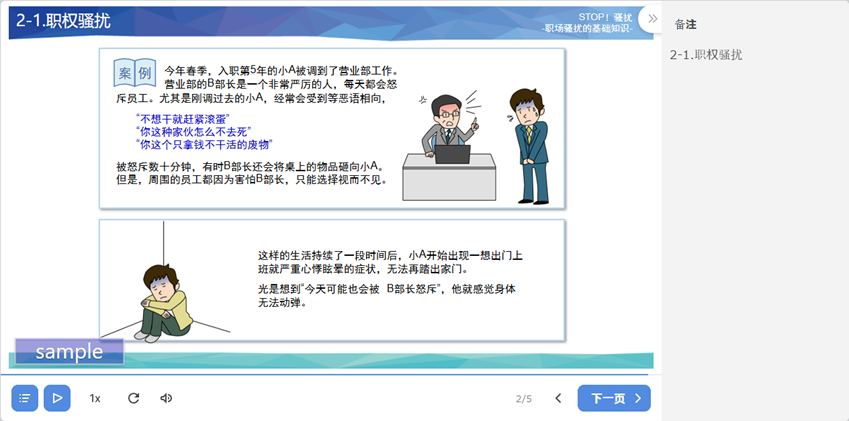
▲E-learning Harassment Training STOP! Harassment – Basic Knowledge of Workplace Harassment (Simplified Chinese Version)
https://hs-learning.jp/service/course/pp_harassment/
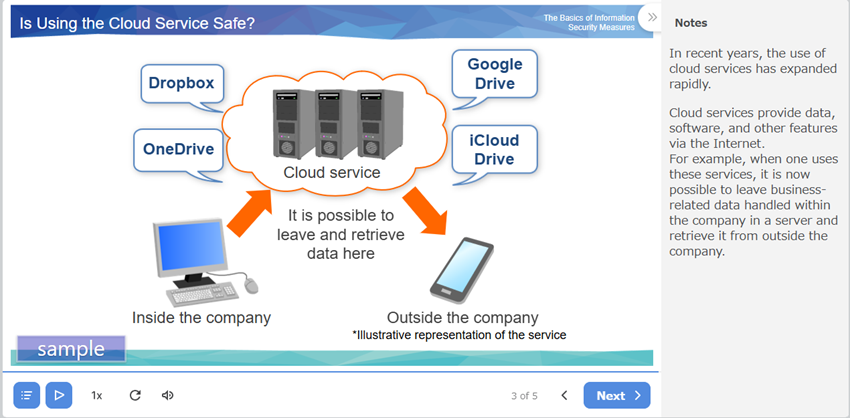
▲Fundamentals of Information Security Measures for Companies (English Version)
https://hs-learning.jp/service/course/pp_infomationsecurity_2/
6. Benefits of Multilingual e-Learning
6-1. Standardizing the Criteria for Understanding
By providing the same training material with only the language changed, you can standardize the criteria for employee understanding.
6-2. Streamlining Education Management
Since attendance status and test results can be centrally managed on the LMS, it leads to more efficient education operations.
6-3. Response to Audits and Internal Controls
Conducting compliance training in multiple languages is an important point for a company's educational system.
7. Case Studies of Multilingual e-Learning Implementation at Human Science
Functional Materials Manufacturer - Information Security Training (Japanese, English, Chinese, Thai, Indonesian, Vietnamese)
Multiple information security training materials introduced for employees at domestic and overseas manufacturing sites.
・Energy-Related Research Institute: Harassment Training Materials (Japanese, English)
As it is a joint research institute with a university, staff of various nationalities are employed.
・Japanese Branch of IT Solution Provider: Harassment Training Materials (Japanese, English)
Customization for the company itself has also been implemented.
・Insurance Company: Harassment and Compliance Training Materials (Japanese, English)
Conducted for employees at domestic and overseas locations.
・Pharmaceutical Company: Compliance Training Materials (English, Simplified Chinese, Korean, Thai, Vietnamese, Portuguese)
Conducted for employees at domestic and overseas locations. Additional case studies included.
8. Frequently Asked Questions (FAQ)
8-1. Which languages are in high demand for e-learning for foreign employees?
In corporate in-house training, there tends to be high demand for English, Chinese, and Vietnamese.
Additionally, depending on the employee composition and industry, languages such as Indonesian and Thai may also be considered.
8-2. How can e-learning be multilingualized?
Multilingualization can be achieved by translating subtitles, narration, test questions, etc., based on the existing Japanese materials.
It is possible to align the comprehension standards by keeping the material structure and questions the same and only changing the language.
By using already multilingual materials, you can shorten the lead time until the start of implementation.
8-3. Which training should be multilingualized first?
Many companies consider multilingualizing mandatory training for all employees, such as harassment training, information security training, and personal information protection training.
Also, English is considered essential, and often the next language to consider is the one with the largest number of participants.
In some cases, the language for the following year is decided based on scores from comprehension tests.
9. Summary
As the number of foreign employees increases, multilingualization of in-house training has become an important theme.
By supporting e-learning in languages such as English, Chinese, and Vietnamese,
it becomes possible to provide common education to all employees while reducing differences in understanding due to language.
For companies considering multilingual deployment of e-learning for multinational employees,
please feel free to consult with us about the available materials and languages.
Do you have concerns such as lacking the resources to create materials in-house, or feeling that the quality of materials produced internally is not good? In such cases, outsourcing material production is also an option.
Human Science has extensive experience in the production of e-learning materials. We leverage our know-how in project management to support everything from planning and design of e-learning. Each project is assigned an experienced dedicated project manager, and a specialized consulting team provides solid support until delivery. If you have any concerns about material production, please feel free to consult with us.
Please see below for each service.
> e-Learning Material Sales
> e-Learning Material Distribution Service - eTraining Portal
> e-Learning Material Production
> e-Learning Material Translation (Multilingual Support, Localization)