







2026.06.10
How e-Learning Production Companies Use AI — The Reality of Contracted Sites in 2026
① Degree of AI Utilization in the Production Process

-
Category
Recommended Articles
-
What is Vyond? Introducing the benefits of an animation video production tool that can be used for business.
-
[Animation Teaching Material Production] How to Create e-Learning Materials ②
-
How does Vyond differ from other animation production software? Comparison and recommendations
-
Can Vyond animations be used as teaching materials? Here are the benefits of using them in e-learning and training.
-
Let's create business animations with Vyond! An explanation of the reasons and benefits recommended for business, as well as challenges.
-
Vyond Go (AI Video Generation) Tips and Best Practices ① Vyond Go Setup Guidelines
-
Moodle Basic Course: What is Moodle?
-
[Moodle Basic Course] What can the e-learning management system Moodle do?
-
[Moodle Basic Course] What can be done with Moodle's default features
-
Benefits and Considerations of Moodle Cloud Services
-
Moodle is not only used by universities (widespread use)



"If you use AI, you can do everything from the curriculum to editing of e-learning materials." Haven't you thought so?
This is partly true, but it also carries various risks and the potential loss of value.
In this article, we will introduce the actual use of AI in our production process from the perspective of an e-learning production company (professional).
1. It started with the question, "Can't AI do everything?"
Inquiry patterns from clients that surged in 2025-2026
While working on projects with many clients, especially over the past year, we have often heard the following comments (as of June 2026).
- ①Can using AI improve efficiency and reduce costs even more?
- ②For now, I created the outline with AI, so I want you to handle the subsequent steps well.
- ③I created the scenario with ChatGPT, so I want this turned into a video.
In fact, records of discussions about AI utilization in business negotiations have been increasing at more than double the pace as shown below.
14 cases in 2025 ➡ 16 cases in 2026 (up to May)
Why This Question Arises — The Rapid Evolution of Generative AI Tools
The increase in inquiries like these is believed to be influenced by the significant advancements in AI. ChatGPT appeared in 2023, followed by image and video generation AI (such as Sora, Veo, etc.) in 2024, and from 2025 onward, developments in AI voice (ElevenLabs, etc.) and AI avatars (HeyGen, Vyond, etc.) have continued, with accuracy improving rapidly.
With this much AI available, it is natural to feel that "as long as a person handles the rest, e-learning can be created." In fact, for short videos and simple quizzes, it is possible to leave the creation to AI.
However, unless the tasks that should be entrusted to AI and those that should be primarily handled by humans are clearly separated, it is difficult to achieve the educational goal of "learning effectiveness" as of 2026.
In the next chapter, let's take a step further and consider where AI should be utilized within the production process.
2. AI Utilization Map for the 10 Steps of e-Learning Production
We have divided the e-learning production process into 10 steps (there are differences depending on the project, so this is just one example). Let's look at the affinity of AI usage in each step.
■10 Steps of eLearning Production
- ① Needs Analysis and Target Setting
- ② Learning Objective Design
- ③ Content Structure Design
- ④ Scenario and Script Writing
- ⑤ Visuals and Illustration Production
- ⑥ Audio and Narration Production
- ⑦ Video Production and Editing
- ⑧ Question and Test Design
- ⑨ LMS Implementation and Distribution
- ⑩Effect Measurement and Improvement
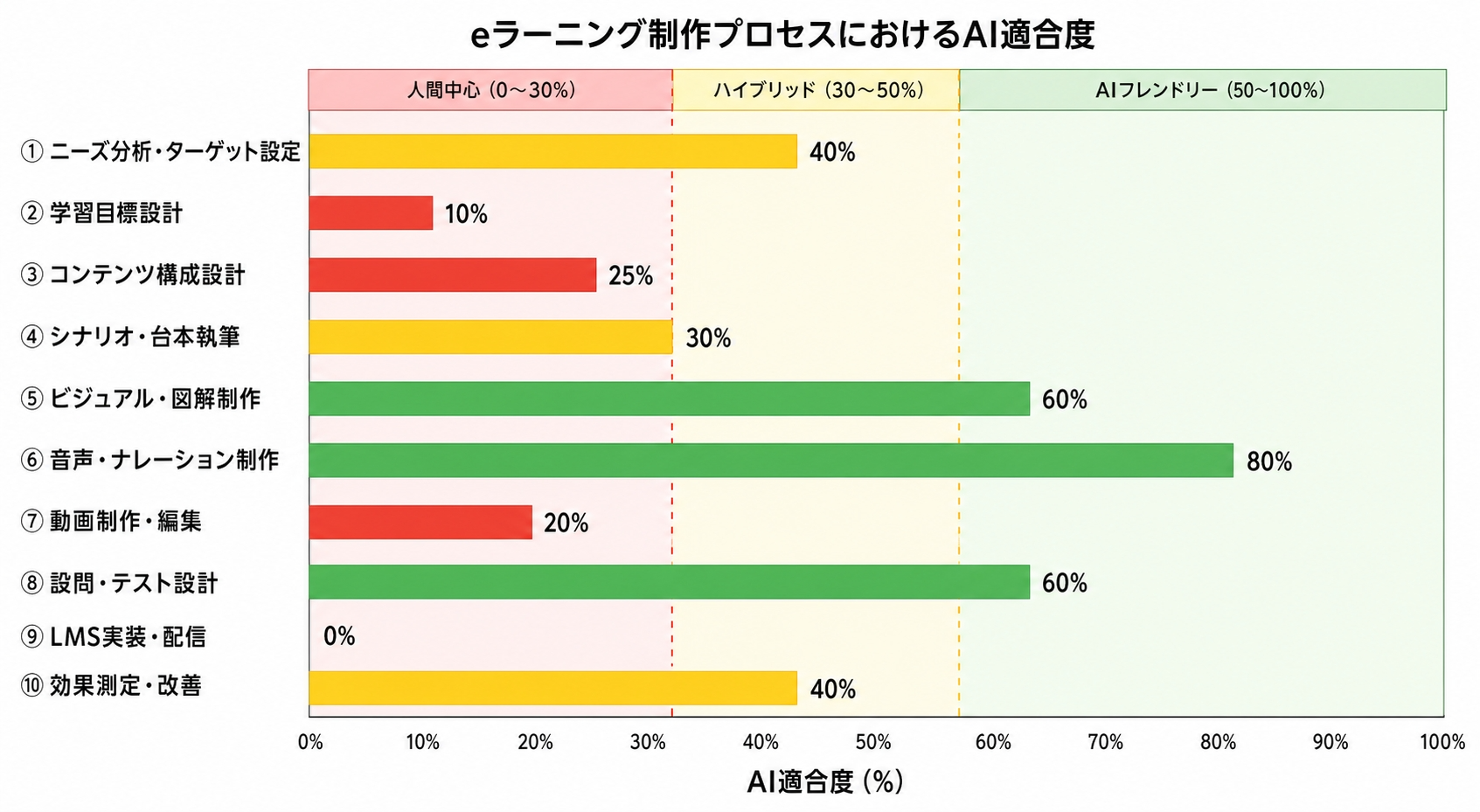
Three Processes Suitable for Collaboration with AI
First, these are the processes where AI can be most effectively utilized; however, the current situation is that a significant amount of manual effort is still required to create highly effective education.
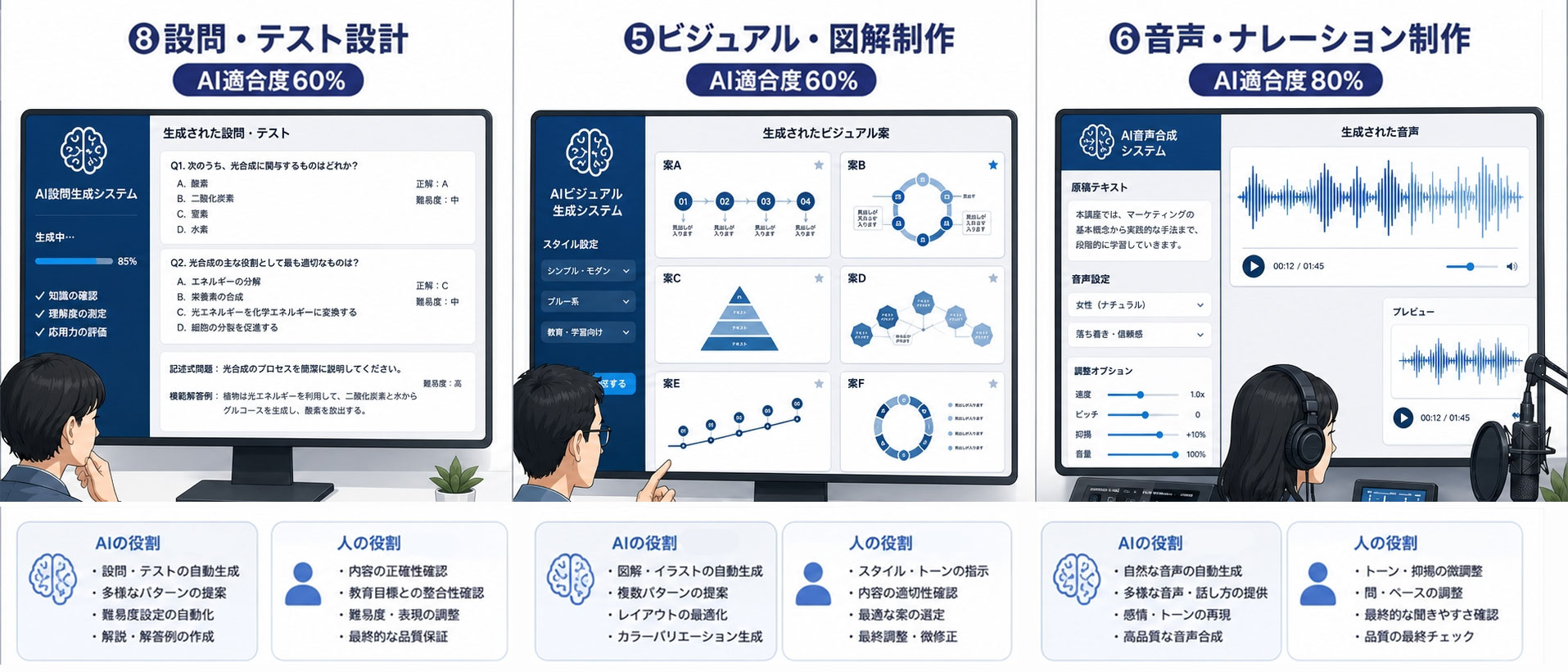
⑧Question and Test DesignAI Compatibility60
- ・Creating quizzes to confirm the achievement of learning objectives ②
- ・Including confirmation that ③ and ④ are linked to ②
The accuracy of question generation has improved, but trick questions may still be produced. Also, there are cases where the AI fails to properly extract the points emphasized by the creator, so the accuracy of the generated results greatly depends on how the AI is used and instructed.
⑤ Visual and Diagram ProductionAI Suitability60
- ・Consideration and creation of visual expressions (including animations) and interactions (may be included in ③④)
Creating illustrations and diagrams aimed at visualizing content and improving design quality is a task AI excels at. However, image generation AI does not always produce the appropriate illustrations needed. Multiple generation attempts are made, directions are given, and the generated images are checked to ensure they do not infringe on the rights of other companies before use.
⑥Audio & Narration ProductionAI Suitability80
Voice is also a field where AI excels. It has become capable of expressing emotions. However, there are issues with reproducibility, as the tone of voice may change each time it is generated, and the reading speed may be off. In some cases, using conventional speech synthesis software is more effective in terms of operational costs.However, it cannot match the expressive power of professional narrators, so it should be used according to the purpose.
Three Processes Where a Hybrid of AI + Humans is Optimal
Next, let's look at items where efficiency can be improved through AI utilization. These are mainly items where AI use is expected for purposes such as information organization.
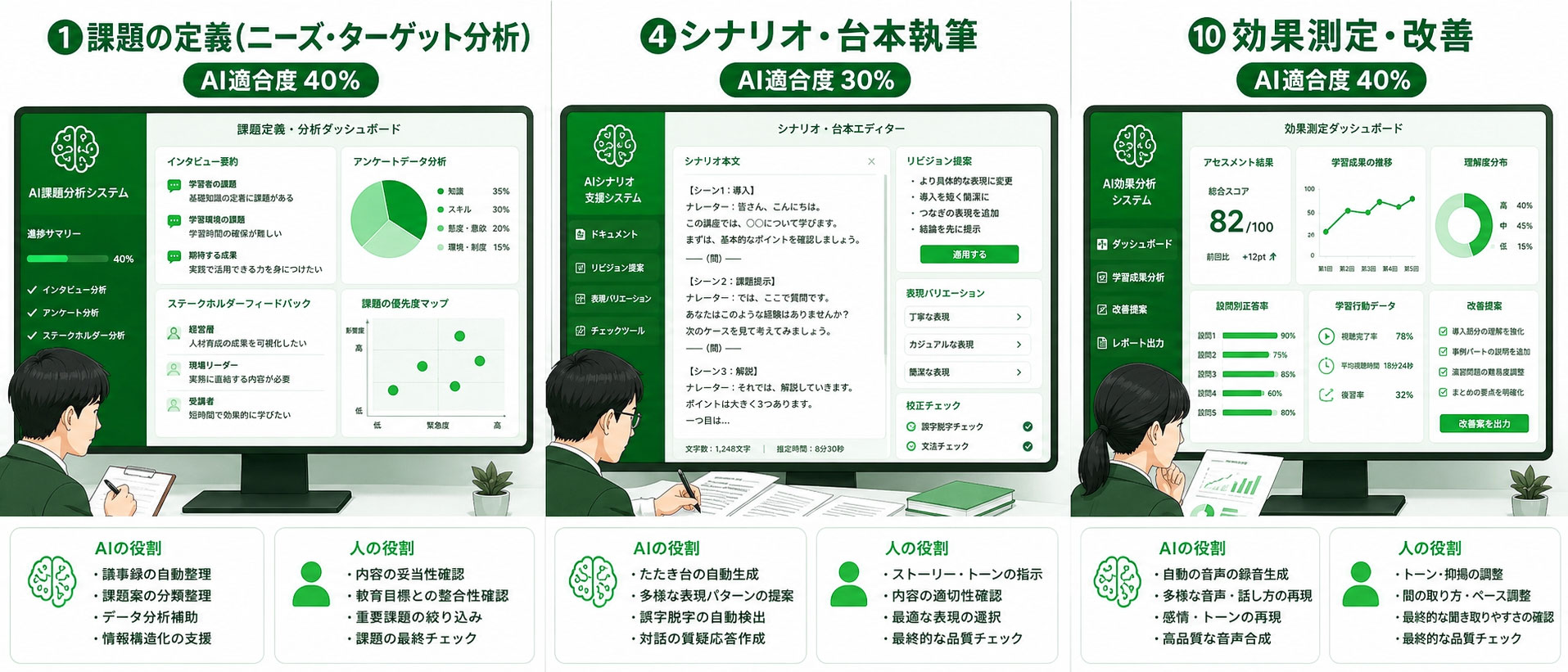
① Definition of Issues (Needs and Target Analysis)AI Suitability40
- A. Understanding management and organizational issues, and top-down educational objectives
- B. Extraction of on-site issues, issue extraction and analysis through on-site interviews and surveys (bottom-up understanding of objectives)
- C. Clarification of educational themes and targets based on the results of A-B (organizing the current status of participants and the learning environment)
This is a fundamental part of the teaching materials. If the education involves conveying general information, AI can help organize it to some extent. However, if you want to include your company's or unique information, it often requires hearing the tacit knowledge from the field, identifying issues while observing the other party's reactions (skills in dialogue and reading the atmosphere), and having prerequisite knowledge of your company or industry. AI usage is limited to tasks such as organizing meeting minutes or sorting out issue proposals.
④Scenario and Script Writing (May be included in ③)AI Suitability30
- ・Based on the results of ① to ③, writing texts and scripts (storyboards) using Excel, PowerPoint, Word, etc.
Once the information from ① to ③ is gathered, AI can be used to generate a draft. However, it is not recommended to use the scenarios or scripts generated by AI as-is. Our company utilizes AI for proofreading written text and generating alternative expressions or phrasing suggestions. Many AIs tend to write based on publicly available information, so even if your company’s information has been trained, it is necessary to review whether the text effectively communicates to people. Additionally, verifying the accuracy of the generated information requires a significant amount of effort.
⑩Effect Measurement and ImprovementAI Suitability40
It is possible to quickly analyze the results of surveys and quizzes, but this analysis is not conducted with a full understanding of the learners' situations or the environments they are in. AI should be used as a supplementary tool for analysis. If there are parts of the production process that can be made more efficient, it is important to actively allocate human resources to these areas to verify the learning effectiveness and apply the findings to future improvements.
Four processes that require human involvement and their structural reasons
Finally, we will introduce processes with low affinity for AI.
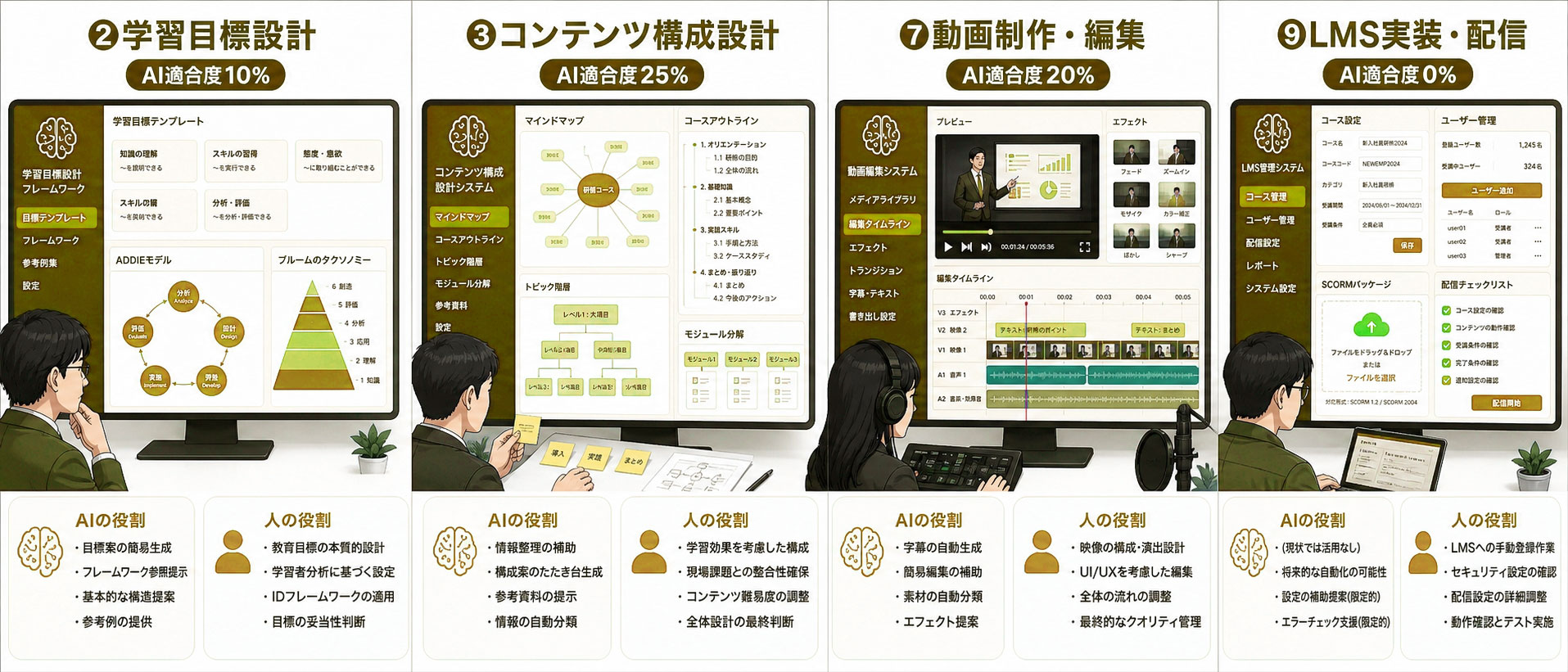
② Learning Objective DesignAI Suitability10
As a response based on the results of ①,
- A. Setting the current situation and the ideal (goal)
- B. Setting learning objectives for each individual course
"Learning objectives" are not only communicated to learners but also serve as a very effective tool for sharing assumptions among AI, humans, and related members in subsequent processes. By providing AI with basic information such as needs and target audience, draft objectives can be easily organized; however, if you have mastered ID (Instructional Design), it is more effective to set goals manually. This will be a great help for those without experience in instructional material development.
③ Content Structure DesignAI Suitability25
- ・Setting the difficulty level of the teaching materials
- ・Designing the table of contents for each individual course based on ② (including title proposals and an overview of the information to be conveyed)
- ・Researching and collecting the original source information and materials
① to ③ are the planning and design stages. If there is a gap between these and the actual issues on site, the value of the content itself will be lost. Since AI also understands the basics of ID (Instructional Design), assistance such as information organization and generating structure proposals by AI is acceptable, but the question of how to create valuable education must always be considered primarily by humans.
⑦Video Production and EditingAI Suitability20
It is also difficult to leave editing work to AI. It is necessary to assemble the content with awareness of the overall flow and UI/UX perspective. Even when generating videos, various editing tasks such as connecting short clips and creating separate audio are required.Some editing software, such as Articulate Rise, has high compatibility with AI and has developed technology to automatically assemble content.
⑨LMS Implementation and DistributionAI Compatibility0
The task of registering the content created in the previous steps into the LMS (Learning Management System) and starting distribution may be automated by AI agents and the like, but manual handling often offers advantages in terms of security and efficiency.
3. Summary
The average AI suitability score is 37.5.
This can be seen as achieving "efficiency" by utilizing AI, but in reality, since time is spent interacting with AI and reviewing AI-generated results, the current situation in many projects is that it leads more to "quality improvement" rather than "efficiency."
However, naturally, "cost" is an important factor for clients when placing orders, so there are also projects that actively use AI with the goal of cost reduction.
This article examined the AI suitability in the production process at e-learning production companies, and in the next blog, "② AI Utilization by Educational Theme", we will introduce how the compatibility with AI varies from a different perspective (by educational themes such as "skill transfer," "compliance," and "hierarchical education").
Related Services
We provide comprehensive support from planning and design to production, including decisions on how extensively to use AI. Please feel free to consult us about e-learning content production.
E-learning Content Production Service (https://hs-learning.jp/service/teaching/)
About the Author