







2026.08.03
How e-Learning Production Companies Use AI — The Reality of Contracted Sites in 2026
③ Production Companies and Clients in the AI Era

-
Category
Recommended Articles
-
What is Vyond? Introducing the benefits of an animation video production tool that can be used for business.
-
[Animation Teaching Material Production] How to Create e-Learning Materials ②
-
How does Vyond differ from other animation production software? Comparison and recommendations
-
Can Vyond animations be used as teaching materials? Here are the benefits of using them in e-learning and training.
-
Let's create business animations with Vyond! An explanation of the reasons and benefits recommended for business, as well as challenges.
-
Vyond Go (AI Video Generation) Tips and Best Practices ① Vyond Go Setup Guidelines
-
Moodle Basic Course: What is Moodle?
-
[Moodle Basic Course] What can the e-learning management system Moodle do?
-
[Moodle Basic Course] What can be done with Moodle's default features
-
Benefits and Considerations of Moodle Cloud Services
-
Moodle is not only used by universities (widespread use)


In the first blog "① AI Utilization in the Production Process", e-learning production was divided into 10 steps, and the degree of AI utilization in each step was analyzed.
Then, in the second blog "② AI Utilization by Educational Theme", the educational content is divided into three categories to convey the actual state of AI utilization.
Table of Contents
The role of production companies shifts from "creators" to "partners and quality guarantors"
This time, as the final part (③) of the three-part series "How e-Learning Production Companies Use AI," I would like to organize thoughts on the role of production companies in the AI era and the relationship with clients who place orders.
I hope this will serve as a reference for the value of outsourcing educational content such as e-learning and the nature of the relationship with clients.
Three new values required of production companies in the AI era
As seen in the past two sessions, the scope of AI's role in e-learning production is definitely expanding. There is no doubt that AI can now assist with parts of the process that traditionally required manual effort and time, such as creating draft manuscripts, generating materials, and drafting question proposals.
On the other hand, the value of educational content itself has not come to be fulfilled solely by AI. Rather, now that AI has become widespread, the role that clients expect from production companies is shifting from "creating" to "collaborating on what and how to communicate," and to "ensuring quality."
As the role of production companies in the AI era, we will introduce the following three capabilities.
① "Design capability" tailored to educational objectives and target audience
② "Partnership capability" to achieve effectiveness through continuous improvement
③ "Quality assurance capability" to guarantee quality
① "Design capability" tailored to educational objectives and target audience
AI excels at summarizing information and proposing structural plans. However, the educational design itself—deciding "to whom, what, in what order, and how to convey information to promote understanding and lead to action"—still heavily relies on human judgment.
To put it simply, even within the same information security training, the necessary examples and expression methods vary depending on whether it is for new employees, managers, or overseas offices. Furthermore, in areas with a lot of company-specific knowledge and judgment criteria, such as product training or skill transfer, simply listing information is not sufficient for effective education; content must be created taking various situations into account.
What customers seek is not "creating materials," but rather "education that reaches learners and is utilized in the field," ultimately achieving business impact. In that sense, production companies are now required more than ever to have not only content creation capabilities but also the design skills necessary to make the education effective.
② "Partnership capability" to achieve effectiveness through continuous improvement
Utilizing AI will likely increase production speed. While this lowers the hurdle of "just creating first," the challenge of how to review and continuously update after release actually becomes greater.
Until now, education tended to focus on simply being conducted, but with AI, there will be more time (capacity) and power (AI assistance) to pursue the effectiveness of that education.
It is required not only to deliver production materials on a one-off basis but also to play the role of a partner who continuously nurtures education. The significant difference going forward will be whether support can be provided not only on how to use AI but also on how to continuously improve education that utilizes AI.
③ "Quality assurance capability" to guarantee quality
While AI can generate many ideas in a short time, it may also include misinformation, unnatural expressions, or explanations that do not fit the context. This is known as hallucination. Especially when AI is fully utilized in educational content, problems such as "it looks plausible but actually fails to convey the message" or "the information appears correct but causes misunderstandings in the field" tend to occur more frequently.
Therefore, production companies are required to have the ability not only to use AI but also to appropriately refine the content generated by AI to suit the target audience. Ensuring the final quality—including the accuracy of the content, naturalness of expression, consistency with learning objectives, and clarity for the learners—is considered an extremely important role.
We fully leverage our foundational skills in technical writing and the communicative power of instructional design (ID) to support education.
The Production Model in the AI Era: "Divergence by AI, Convergence by Humans"
In our production environment, we consciously assign roles based on AI's strengths and weaknesses. The principle is simple: AI handles "divergence," generating quantity and variety, while humans take charge of "convergence," narrowing down options and making final decisions.
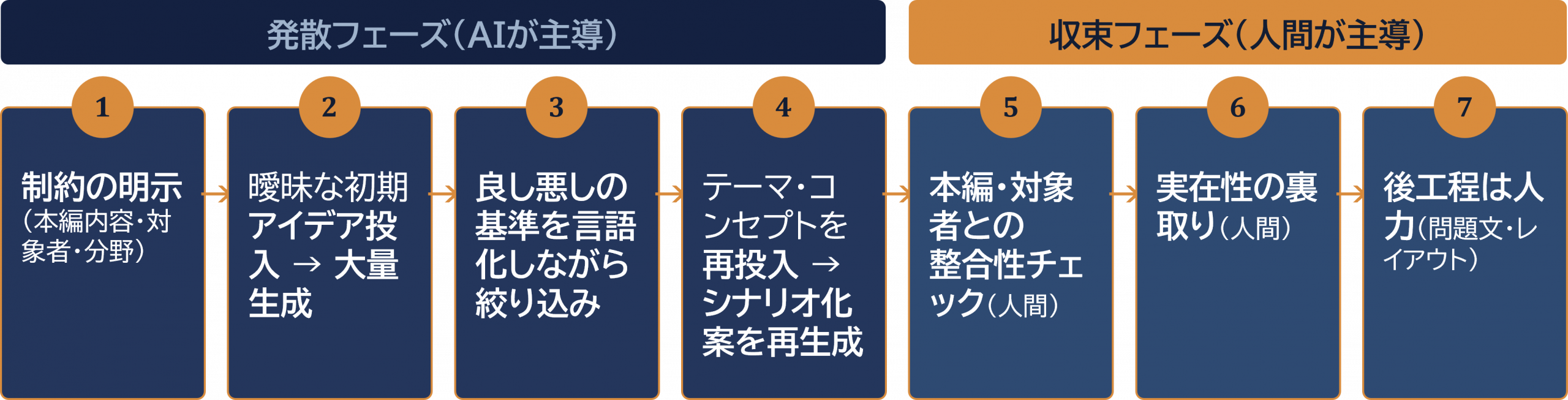
Specifically,
① Share the constraints of the target audience and content with AI
② Have AI generate a wide range of ideas
③ Narrow down while humans verify consistency with the main content and target audience, as well as factual accuracy
This is the flow. The more plausible the output looks, the more important it is to always verify it before mixing it into the next process — this approach is common across planning-related tasks such as training design and scenario creation. By accumulating this process, we will achieve both efficiency and quality improvement.
A Shift in Mindset from "Outsourcing" to "Collaboration"
In traditional educational content production, it was common to outsource the production process with the approach of "we provide the necessary content, so please just make it look nice." Of course, this method is still widely used today, but with the spread of AI, there are increasing cases where this alone does not lead to sufficient results.
What is important is not outsourcing the entire production or just the tasks, but rather jointly considering how to organize your company's knowledge and challenges and at which stages to leverage the expertise of the production company.
In this sense, the relationship with production companies from now on fits reality better when viewed not as "outsourcing destinations" but as "collaborative partners." The client shares their background and challenges, the production company designs it as education, and together they shape it by selecting appropriate methods, including AI. Through this back-and-forth, more effective content is created.
By both companies taking responsibility for the outcomes of the educational content, it is possible to realize more effective content, especially in education that involves a large amount of company-specific information or requires behavioral change.
In the AI era, the value of production companies is no longer just about "doing the hands-on work." It involves organizing the purpose of education, structuring the necessary information, designing the division of roles between AI and humans, and accompanying the process with a focus on the final quality and results. We believe that this form of collaboration will become the essential value in future e-learning production.
Checklist for Clients Starting to Utilize AI
As we have seen so far, the important point in utilizing AI in e-learning production is to determine, based on your company’s educational themes, internal structure, and desired outcomes, how far to proceed with AI and from where humans should take over.
In practice, some companies are better off producing everything in-house, while others achieve better results by collaborating with external production companies. Additionally, depending on the educational theme, a hybrid approach may be reasonable—using AI and existing content (including commercial content) for the foundational parts, while creating only the more challenging parts that require high originality together with external partners.
For clients who are just starting to utilize AI, it is recommended to first refer to the following checklist and organize an approach that suits your company.
Criteria for Deciding Between In-house, Outsourcing, and Hybrid
If you are unsure about the necessity of outsourcing, please consider the following perspectives.
How much company-specific information is included in the educational content
If your company has a lot of unique knowledge and tacit knowledge, the difficulty of production increases.
Is the purpose of the training "information transmission" or "behavioral change"?
If you want participants not only to understand but also to change their behavior or judgment, careful design and expression are necessary.
Whether there are experienced personnel in instructional design and content creation within the company
If there are no experienced personnel, please consider consulting with external parties from the requirements definition stage, including how to proceed.
Whether there is an operational system that can continuously update and improve
It is necessary to continuously review and update according to the need for content changes and the reactions of the learners. It may be more practical to share roles with an external production company.
Is there someone who can verify quality?
It is necessary to ensure not only the AI-generated content but also that the created material is accurate and expressed in an easily understandable manner. Collaborating with external parties may be safer in some cases.
Can you establish a system for measuring effectiveness?
Only when you can confirm what should be improved for the next time does it have meaning as an educational initiative. It is important to consider in advance how to measure the effectiveness.
Is the approach appropriate for the scale of the participants?
When the number of participants is large, or when multilingual deployment or differentiation by job type is required, the difficulty of design and management also increases. In many cases, it is more efficient to proceed with standardization and quality control while receiving external support.
Summary
The potential for AI utilization is certainly expanding. However, the approach that suits your company varies greatly depending on the educational content and system.
When you want to clarify "how far to proceed with AI" and "which is suitable: in-house, outsourcing, or hybrid," it is important to consider the educational themes and operational structure. Identifying an approach that is feasible for your company is the first step to successfully leveraging AI.
Related Services
We provide comprehensive support from planning and design to production, including decisions on how extensively to use AI. Please feel free to consult us about e-learning content production.
E-learning Content Production Service (https://hs-learning.jp/service/teaching/)
Supervisor Information