








2026.11.19
What Is the Current State of AI Use in Universities and What Challenges Remain? The Potential of Educational Digital Transformation with Moodle

-
Category
Recommended Articles
-
[Moodle Manual ③] 2025 Edition | Support Staff Explain How to Set Up and Utilize Forums!
-
[Moodle Manual ②] 2025 Edition|How to Create Quizzes, Setup Procedures, and FAQ Explained by Support Staff!
-
[Moodle Manual ①] 2025 Edition|How to Set Assignments & Tips for Use Explained by Support Staff!
-
What is Vyond? Introducing the benefits of an animation video production tool that can be used for business.
-
[Animation Teaching Material Production] How to Create e-Learning Materials ②
-
How does Vyond differ from other animation production software? Comparison and recommendations
-
Can Vyond animations be used as teaching materials? Here are the benefits of using them in e-learning and training.
-
Let's create business animations with Vyond! An explanation of the reasons and benefits recommended for business, as well as challenges.
-
Vyond Go (AI Video Generation) Tips and Best Practices ① Vyond Go Setup Guidelines
-
Moodle Basic Course: What is Moodle?
-
[Moodle Basic Course] What can the e-learning management system Moodle do?
-
[Moodle Basic Course] What can be done with Moodle's default features
-
Benefits and Considerations of Moodle Cloud Services
-
Moodle is not only used by universities (widespread use)



In recent years, the use of generative AI in universities has expanded. Generative AI tools such as ChatGPT and Microsoft Copilot are now used not only for teaching and research, but also for the day-to-day work of faculty and staff.
At the same time, challenges have emerged: faculty and staff may be slow to adopt generative AI even after it is introduced, universities may be unsure how to establish rules for student use, and methods for assessing reports and assignments may need to be reconsidered. In this context, learning management systems (LMSs) used by universities are also expected to play new roles.
This article examines the current state and challenges of generative AI use in universities, considering emerging trends and practical challenges, and explains how to develop an educational environment using the open-source LMS Moodle.
1. The Growing Use of Generative AI at Universities

The use of generative AI at universities is expanding from experimental trials to practical applications in education, research, and university operations. In recent years, some universities have introduced generative AI tools such as Microsoft Copilot across their institutions, promoting their use in teaching and administrative work.
In addition to teaching and research, university faculty and staff are responsible for a wide range of tasks, including preparing meeting materials and documents, gathering information, and organizing data. Using generative AI for these tasks can save time and improve efficiency. However, simply introducing generative AI tools does not guarantee that they will become part of everyday practice.
However, the extent to which generative AI is used varies from person to person. While some faculty and staff actively incorporate it into teaching and administrative work, others have limited opportunities to use it, often resulting in uneven adoption across the university. To establish generative AI as a regular practice, it is important not only to provide tools but also to share practical examples, communicate precautions for their use, and offer training for faculty and staff.
Universities need to consider how to use generative AI in education and operations, rather than treating its adoption as an end in itself.
2. Student AI Use: From Prohibition to Appropriate Use

One particularly important issue in the use of generative AI at universities is its use by students. Since generative AI first became widespread, concerns have included its use to write reports on students' behalf, other inappropriate uses, and the submission of assignments without a sufficient understanding of the material.
At the same time, generative AI can help students look up unfamiliar terms, obtain explanations of complex topics, and organize their thoughts. Therefore, rather than imposing a blanket ban on generative AI, it is important to establish appropriate ways to use it based on educational objectives and the nature of each assignment.
Rather than imposing a blanket ban on students' use of generative AI, many universities are moving toward allowing its use under rules tailored to educational objectives. For example, universities are developing policies to encourage appropriate use, such as requiring students to disclose when they have used generative AI in reports or assignments and clearly specifying the permitted scope of use.
To advance these efforts, students also need to understand the capabilities and limitations of generative AI. For example, they need opportunities to learn that generative AI can produce inaccurate information and that care must be taken when handling the information they enter.
Universities are expected to establish rules for the use of generative AI and provide AI literacy education to help students use it appropriately.
3. Assessing Learning in the AI Era

The spread of generative AI is also affecting how universities assess learning. Traditionally, universities have assessed students' understanding and learning outcomes through reports, exams, and other means. However, because generative AI makes it easy to produce written work and answers, submitted work alone may not be enough to fully assess students' own understanding or thought processes.
As a result, the following considerations are likely to become increasingly important:
・Whether students themselves understand what they have learned
・Whether they can explain and analyze ideas based on their own thinking
・Whether they can critically evaluate responses from generative AI
・How and for what purposes they used generative AI
For example, in addition to submitting reports, students could reflect on their writing process, take quizzes to check their understanding, and participate in discussions.
What matters is not just whether students have used generative AI, but also appropriately assessing how they have learned and what they have gained. This requires reviewing teaching and assessment methods, as well as creating an environment that can continuously support and manage students' learning activities.
4. The Role of LMSs in the AI Era

As the use of generative AI expands in universities, renewed attention is being paid to the role of learning management systems (LMSs). An LMS supports university teaching activities, including the distribution of course materials, assignment submission, online testing, and grade management.
In the age of generative AI, LMSs are expected to support the following initiatives in addition to providing these functions.
• Communicating guidelines for the use of generative AI
• Providing AI literacy education for students, faculty, and staff
• Centrally managing learning materials and activities
• Managing learning records, such as assignment submission status and test results
• Monitoring student progress and using the information to improve teaching
For example, an LMS can be used to provide guidelines on the use of generative AI and learning materials, as well as to administer quizzes to check understanding. Information such as access to learning materials, assignment submissions, and test results can also provide insights into students' learning progress.
However, LMS learning records alone cannot reveal how students have used external generative AI tools. Rather than treating the LMS as a system that automatically tracks all student learning activities, it is important to use it as a foundation for managing educational activities and monitoring learning progress.
5. AI Applications in Moodle

Moodle is an open-source LMS used by educational institutions and businesses around the world. In addition to features such as distributing learning materials, submitting assignments, administering tests, and managing grades, it supports customization and functional extensions through plugins. Moodle also provides mechanisms for integration with generative AI, expanding the possibilities for using AI in education.
Here, we introduce ways to use AI with Moodle.
Improving efficiency in teaching tasks
・Support for creating questions
Moodle's standard features do not include generative AI-powered question creation. However, plugins or custom development that integrate generative AI services such as the OpenAI API or Azure OpenAI Service can generate draft questions based on teaching materials or specified topics, helping teachers create questions.
For example, a system could be built in which teachers review and revise questions generated by AI before adding them to Moodle's question bank. However, AI-generated questions may contain factual errors or inappropriate answer choices, so teachers must review their content before using them in actual classes or exams.
• Support for creating teaching materials
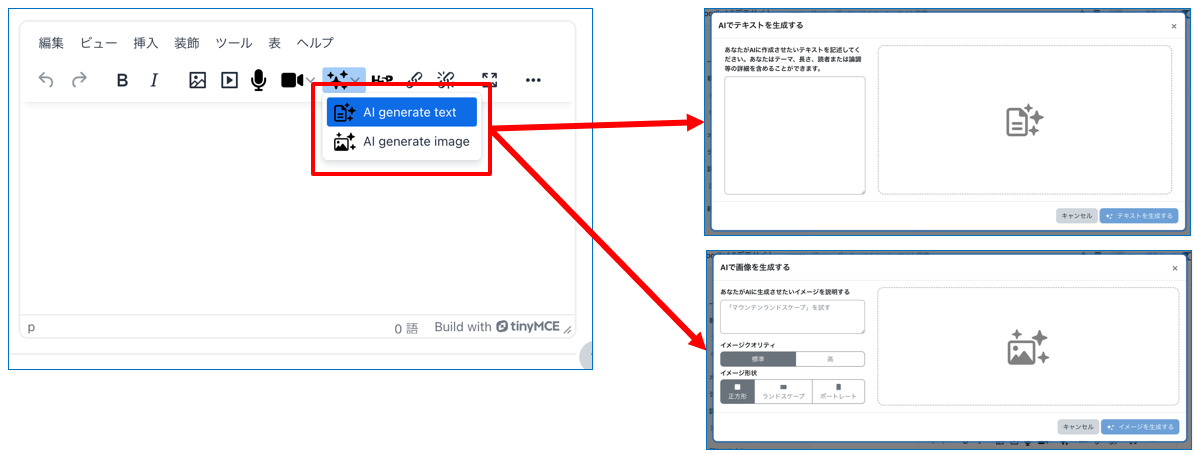
In Moodle 4.5 and later, the AI Subsystem (an AI feature for integrating with generative AI services) can connect to external AI services such as OpenAI and Azure AI, enabling text generation, summarization, image generation, and more. These features can help create explanatory text for teaching materials, supplementary resources, and images for use in class.
Available features vary depending on the Moodle version and the AI provider in use. In Moodle 4.4 and earlier, installing plugins or additional development may be required to use similar features. It is also important for teachers to verify the accuracy and appropriateness of generated content before using it.
Example: Text and image generation can be used from the text editor.
Supporting personalized student learning
Generative AI can also help students learn at their own pace and according to their level of understanding.
• Explaining learning content
In Moodle 4.5 and later, the AI Subsystem can be used to connect to external generative AI services. This may help explain terms in learning materials, rephrase text, and generate supplementary explanations. Available features vary depending on the configured AI service and installed plugins.
・Answering questions
Moodle's standard features do not include generative AI-powered question answering, but AI chat plugins or additional development may make it possible to build a system that answers students' questions.
For example, a system that answers questions by referring to course materials and FAQs could support students' independent learning and reduce the burden of inquiries on instructors. Implementing such functionality requires careful consideration of the AI service, integration method, and configuration of any additional systems.
• Content summarization
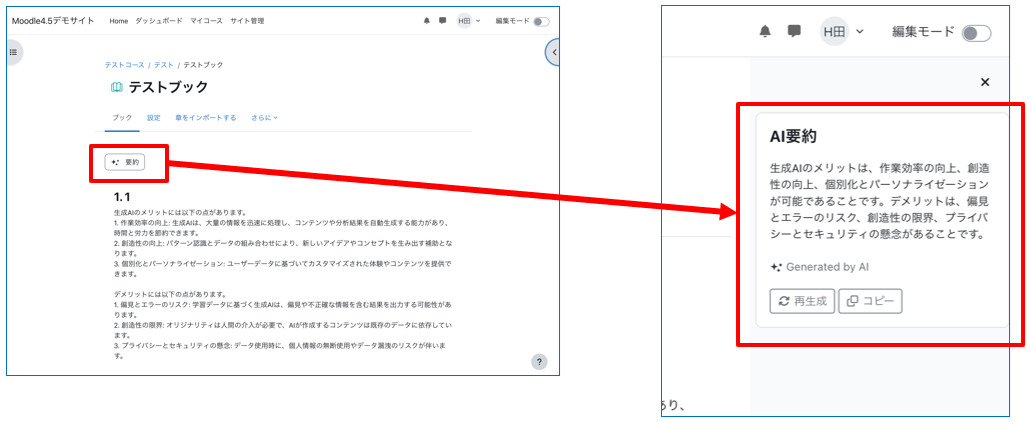
In Moodle 4.5 and later, it may be possible to use the summarization features of external AI services through the AI Subsystem. These features can help organize the key points of learning materials and course content, providing an overview before study or supporting review afterward. Available features vary depending on the Moodle version and the AI provider in use.
Example: You can use the summarization feature to summarize content.
Moodle as an educational platform supporting the use of AI
For universities, simply making generative AI available is not enough. It is important to use generative AI appropriately in educational activities to improve learning outcomes. Moodle enables centralized management of learning materials, assignments, tests, learning histories, and more.
Moodle can therefore serve as a platform for educational activities, including AI literacy education and learning assessment. Its open-source nature and extensibility also allow universities to consider adding or customizing features to suit their educational policies and operational requirements.
Considerations for Introducing AI into Moodle
For universities already using Moodle, an important consideration is what AI features can be added to their current environment.
Specifically, the following points need to be considered.
• The version of Moodle currently in use
• The desired AI features and how to implement them
• What can be achieved with Moodle's standard features
• Whether plugins or additional development are needed
• How to integrate external AI services
• How personal information and educational content data are handled
• API usage fees and operating costs
These considerations also vary depending on the university's existing systems and educational policies. When introducing AI features, it is important to consider not only the technical aspects but also how they will be used in actual educational activities.
Note: Some of the generative AI use cases presented in this article can be implemented using Moodle's standard features, while others require plugins, integration with external AI services, or additional development. Available features and implementation methods vary depending on the Moodle version, the AI provider in use, the system configuration, and operational policies.
6. Conclusion: An Educational Foundation for AI Use in Universities
The use of AI in universities is expected to continue expanding across education, research, and university operations. At the same time, challenges remain, including encouraging adoption among faculty and staff, ensuring appropriate AI use by students, providing AI literacy education, and assessing learning outcomes.
To address these challenges, it is important not only to introduce generative AI tools but also to create an environment where they can be used appropriately in educational activities.
Moodle can be used as an LMS to support university education, including the management of learning materials and learning records. Integration with generative AI and extended functionality can also open up new possibilities for learning support.
Human Science Co., Ltd. provides Moodle implementation, development, and operational support, as well as customization tailored to each university's educational environment and operational requirements.
For universities already using Moodle, we can also help assess how AI can be used in their current environment and whether plugins or additional development are needed.
If you are considering implementing generative AI with Moodle or pursuing digital transformation in university education, please contact Human Science Co., Ltd.
> Related blog posts:
We Tried Moodle AI! A Comprehensive Guide to the Latest Features, Implementation, and Noteworthy Plugins
How Can ICT Be Used in University Education? Practical Approaches and Examples
> Service Site:
Moodle Setup, Implementation and Operation Support Services
About the Author