








2026.06.29
Introducing the Meaning, Importance, and Examples of Critical Thinking! Explained from the Perspective of Training Implementers

-
Category
Recommended Articles
-
What is Vyond? Introducing the benefits of an animation video production tool that can be used for business.
-
[Animation Teaching Material Production] How to Create e-Learning Materials ②
-
How does Vyond differ from other animation production software? Comparison and recommendations
-
Can Vyond animations be used as teaching materials? Here are the benefits of using them in e-learning and training.
-
Let's create business animations with Vyond! An explanation of the reasons and benefits recommended for business, as well as challenges.
-
Vyond Go (AI Video Generation) Tips and Best Practices ① Vyond Go Setup Guidelines
-
Moodle Basic Course: What is Moodle?
-
[Moodle Basic Course] What can the e-learning management system Moodle do?
-
[Moodle Basic Course] What can be done with Moodle's default features
-
Benefits and Considerations of Moodle Cloud Services
-
Moodle is not only used by universities (widespread use)



In the business field, the ability to make the "optimal decision" from vast amounts of information is required. At the core of this is "critical thinking." This is not simply about "doubting," but a skill to view things from multiple perspectives and think logically based on evidence, which is indispensable for problem-solving, decision-making, and communication.
In this blog, we will clearly explain the overview and benefits of critical thinking, and also introduce example problems and training methods that can be practically used in training sessions. We hope this will be a useful reference for training managers who want to enhance their employees' thinking skills.
1. What is Critical Thinking?

First, let's grasp the basic knowledge of critical thinking.
● What is Critical Thinking?
Critical thinking is a way of thinking that considers things objectively, from multiple perspectives, and rationally.
Instead of accepting given information as is, it involves questioning whether "we are interpreting it in a way that suits our company (or ourselves)" or "are there other viewpoints?" and making judgments based on evidence. It can also be described as a "thinking skill" that eliminates assumptions and biases to lead to more reliable conclusions.
●Difference from Logical Thinking and Lateral Thinking
Often confused, "Logical Thinking" (logical reasoning) and "Lateral Thinking" (horizontal thinking) have different purposes. Logical Thinking is a method of thinking that follows a clear line of reasoning, while Lateral Thinking is a method of thinking that flexibly generates ideas without being bound by common sense.
Each of these three thinking methods has its own distinct strengths. By discerning information through critical thinking, structuring reasoning with logical thinking, and generating new ideas using lateral thinking—acquiring all three in a balanced way enables higher-quality decision-making in the business field.
●The Importance of Critical Thinking
In today's rapidly changing business environment, it is essential to accurately evaluate information and make precise decisions. Critical thinking is not only crucial for enhancing problem-solving and decision-making abilities but also indispensable for fostering constructive discussions and improving the quality of decision-making within teams.
To survive in an uncertain and unpredictable era, critical thinking can be said to be an indispensable skill for every business person.
2. Benefits of Strengthening Critical Thinking
When each employee acquires critical thinking skills, it not only improves individual abilities but also becomes a key factor in enhancing the overall productivity of the company. This chapter introduces the benefits of implementation and development from the company's perspective.

〈Merit.1〉Improvement in Employees' Problem-Solving Skills
By mastering critical thinking, employees can analyze issues from multiple perspectives without being swayed by emotions or customs, enabling them to derive fundamental solutions. As a result, the speed and accuracy of preventing recurrence and improving operations increase, fostering "on-site autonomous capability."
〈Merit.2〉Objective judgments based on facts are effective in fostering a data-driven culture
By enabling decisions based on data and evidence rather than subjective views or experience, it prevents personalized decision-making and allows for highly transparent management.
〈Merit.3〉Smoother and More Active Internal Communication
By verbalizing the thought process and being able to explain with evidence, conflicts of opinion transform from "confrontation" into "constructive discussions." As a result, open and healthy communication is fostered, leading to strengthened team unity and trust.
〈Merit.4〉Creation of New Ideas
Questioning existing assumptions and thinking without being bound by common sense forms the foundation for new ideas. By acquiring critical thinking, one can develop from asking "why" to "how," leading to practical and innovative ideas.
〈Merit.5〉Improved Accuracy in Risk Prediction for Strategic Planning
A major advantage is the ability to identify unexpected risks and blind spots in advance at the time of strategic planning. By repeatedly examining from multiple perspectives, troubles during the execution phase can be prevented beforehand, enabling the construction of higher-quality business strategies.
〈Merit.6〉Strengthening Decision-Making Ability of Management
Critical thinking is an essential skill for enhancing the decision-making capabilities of managers and leaders. It enables them to evaluate the opinions of subordinates and those around them without being influenced by emotions, allowing them to make judgments that lead to the optimal solutions for the organization and demonstrate higher-quality leadership.
Employees honing their "thinking skills" leads to the evolution into a "company resilient to change." The introduction and development of critical thinking can be considered the "best investment" that supports long-term competitiveness.
* Data-driven refers to a method of making decisions and taking actions based on "data" such as sales data and customer data.
3. Example Questions and Sample Answers for Critical Thinking

Here, to practically understand critical thinking, we introduce example questions and sample answers based on actual business scenes.
[Case 1]
"The reason the growth speed of young employees is slowing down is because the frequency of training is low."
(Points to Consider)
□ What age and years of service define "young employees"?
□ By which indicators is the slowdown in growth speed being judged?
□ Besides the frequency of training, are there other factors such as the supervisor's coaching style, workload, or support system?
→ It is important to formulate hypotheses and seek data or facts that can verify them.
【Case 2】
"The low rate of men taking childcare leave is because they are concerned about their supervisors' reactions. A company-wide initiative, such as supervisors taking leave themselves, is necessary."
(Points to Consider)
□ Is the supervisor's attitude really the main factor?
□ What is the acquisition rate among supervisors?
□ Are there other factors behind the low acquisition rate, such as systemic issues, task personalization, or concerns about salary?
□ How much influence does the supervisor's acquisition have?
→ It is necessary to verify this using objective data such as case studies from other companies and employee surveys.
[Case 3]
"Regarding the new capital investment in the factory, since there is data showing improved productivity, our company should also introduce it."
(Points to Consider)
□ Under what conditions was the "productivity improvement data" obtained?
□ Does it apply to our company's environment and workforce composition?
□ What is the ROI (Return on Investment)?
□ Are there other methods to achieve equivalent effects besides implementation?
→ It is essential to verify the reliability of the data and conduct comparative examinations.
In this way, the key to critical thinking is to repeatedly engage in "fact-checking," "questioning assumptions," and "considering multiple perspectives." "Improving the quality of thinking = improving the quality of questioning." Avoid jumping to superficial conclusions and always maintain an attitude of reviewing the evidence, which fosters sound judgment.
4. Key Points for Critical Thinking Training
Critical thinking is not something you acquire from just one training session. It requires repeated awareness in daily work and strengthening through practice. Here, we introduce key points for effective training.
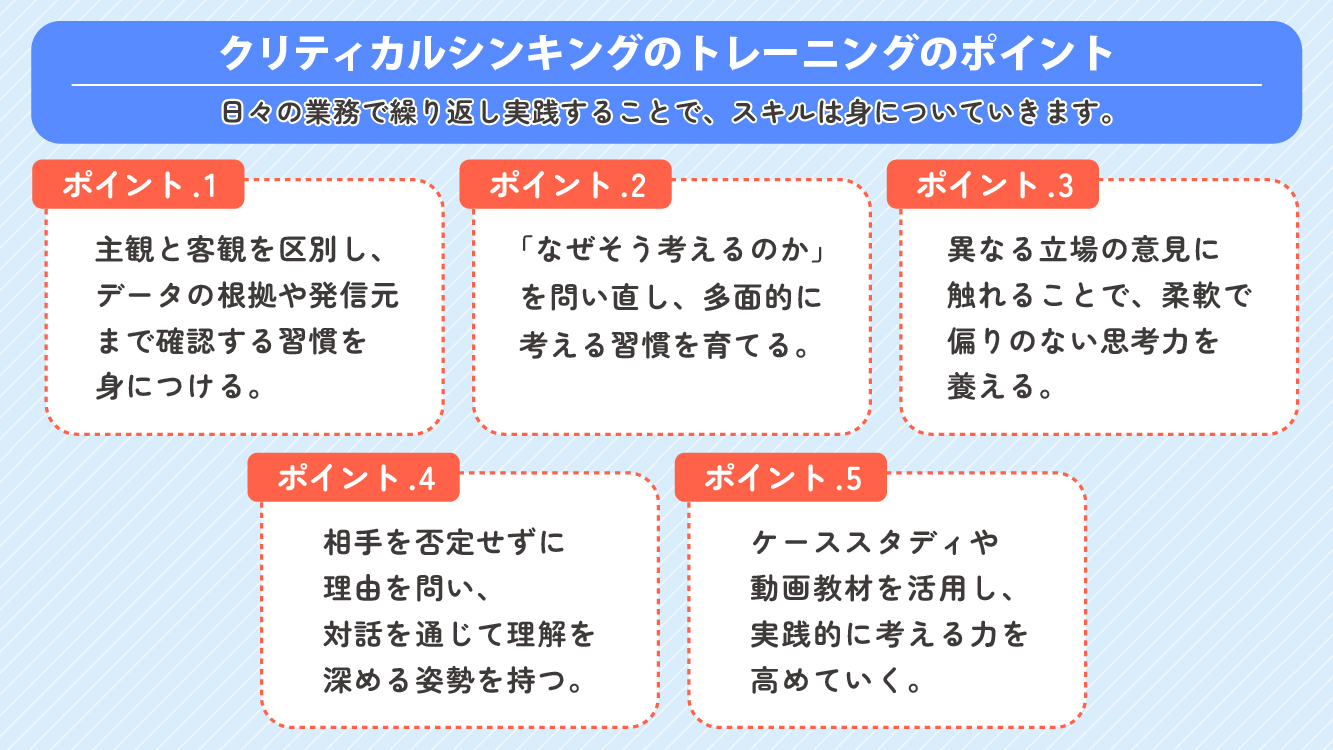
<Point.1> Determine whether a claim is a subjective opinion or an objective fact based on data
In training, it is effective to ask learners, "Is that a fact or an opinion?" when they express their views. Being able to distinguish between subjective impressions and objective evidence improves the quality of discussions. Also, even numbers and data that appear objective at first glance can be biased due to the interests or intentions of the source. It is important to avoid accepting information at face value and to verify the source and purpose.
〈Point 2〉Question assumptions and biases
Develop the habit of asking, "Why do you think so?" and "Are there other possibilities?" Within the training, deliberately presenting opinions from different perspectives can encourage learners to think from multiple angles.
〈Point.3〉Look at things from multiple perspectives
Relying on a single perspective carries the risk of making incorrect judgments. For example, conducting group work with members from different departments, job roles, ages, and genders allows participants to experience diverse viewpoints and broadens the scope of their thinking.
〈Point 4〉Have an attitude of engaging in discussions without fearing interpersonal friction
Critical thinking emphasizes "constructive dialogue." In training, strive to create an atmosphere where participants feel safe to speak even when opinions clash, and foster an attitude of deepening mutual understanding by asking "why do you think so?" rather than denying the other person.
〈Point.5〉Utilize Teaching Materials to Enhance Learning Effectiveness
By using case studies and scenario materials based on actual work, it becomes easier to relate abstract theories to one’s own experience. Additionally, combining video materials and e-learning creates an environment where learners can repeatedly study at their own pace.
What is important in critical thinking training is to "make learners think" rather than simply "teach." Supporting learners in formulating their own questions and deepening their thinking process is the key factor that leads to successful training.
5. Summary

In today’s rapidly changing society, individuals who can accurately discern information and make logical judgments are a great asset to companies. In other words, acquiring critical thinking skills is no longer just an "individual skill" but can be considered a “strategic weapon” to strengthen the company. Therefore, it is highly effective for management and HR departments to take the lead in incorporating critical thinking into employee training.
If you are unsure how to design critical thinking training or want to introduce training easily, we recommend Human Science's e-learning教材 service.
〈E-learning教材〉
– For young and mid-level employees – Critical Thinking
This content is designed to cultivate critical thinking skills—the ability to think objectively, from multiple perspectives, and rationally—toward challenges faced by young and mid-level employees in their work. Learners will become aware of their own thinking habits, organize evidence using frameworks, and practically develop skills to create persuasive proposals and presentations.
It is ideal for those who feel challenges such as "proposals not being communicated effectively" or "discussions not coming together."
Human Science's e-learning material service offers the following advantages.
◎ Choose from 7 themes, including "Critical Thinking"
◎ Since it is in PowerPoint format, you can freely customize it with your company's unique cases and expressions
◎ Available for use from one month per material, allowing flexible implementation only when needed
◎ Supports English and Chinese, making it ideal for companies aiming for global expansion
If you have any questions or concerns about implementation, please feel free to contact Human Science.
>Critical Thinking for Young and Mid-Level Employees
>e-Training / Educational Material Sales Service
Supervisor Information