








2026.05.18
What is the difference between logical thinking and critical thinking? Explanation of how to differentiate them, improve productivity, and help employees acquire these skills

-
Category
Recommended Articles
-
What is Vyond? Introducing the benefits of an animation video production tool that can be used for business.
-
[Animation Teaching Material Production] How to Create e-Learning Materials ②
-
How does Vyond differ from other animation production software? Comparison and recommendations
-
Can Vyond animations be used as teaching materials? Here are the benefits of using them in e-learning and training.
-
Let's create business animations with Vyond! An explanation of the reasons and benefits recommended for business, as well as challenges.
-
Vyond Go (AI Video Generation) Tips and Best Practices ① Vyond Go Setup Guidelines
-
Moodle Basic Course: What is Moodle?
-
[Moodle Basic Course] What can the e-learning management system Moodle do?
-
[Moodle Basic Course] What can be done with Moodle's default features
-
Benefits and Considerations of Moodle Cloud Services
-
Moodle is not only used by universities (widespread use)



In the business field, the ability to think is required to accurately address complex issues and efficiently produce results. Among these, "logical thinking" and "critical thinking" are attracting attention. Both are essential skills for problem-solving and decision-making, but there are clear differences in their characteristics and appropriate usage.
This time, while organizing the differences and key points for distinguishing between the two, we will broadly explain why critical thinking is effective in improving the productivity of organizations and teams, and how employees should be trained to acquire it.
>Reference blog: How to Prepare e-Learning Materials? Explanation of Acquisition Methods and Tips for Creating Excellent Materials! | e-Learning Blog |
Table of Contents
1. What is Logical Thinking?
2. What is Critical Thinking?
3. Differences Between Logical Thinking and Critical Thinking
4. Four Steps to Sharpen Thinking Using Logical and Critical Thinking
5. How to Improve Organizational and Team Productivity with Critical Thinking
6. How to Help Employees Acquire Critical Thinking Skills
7. Summary
1. What is Logical Thinking?
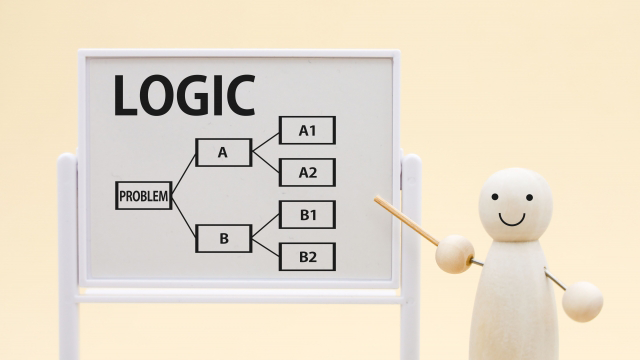
<What is Logical Thinking>
Logical thinking is a method of thinking translated as "logical thinking" or "logical way of thinking" in Japanese. It is the ability to organize complex matters and logically derive conclusions, and is required in all business situations.
〈Main Characteristics of Logical Thinking〉
● Logical and coherentThere is consistency in the flow from premises to conclusion, developed in a way that anyone can understand and agree with. This creates "persuasiveness" in explanations and commentary.
● Well-organizedEven complex information becomes easier to grasp as a whole when structured through systematization or grouping.
●UnbiasedAvoids biased judgments based on preconceived notions or emotions, enabling an objective perspective to accurately assess matters.
●RationalA stance of choosing the most reasonable method or conclusion based on the purpose and conditions. Judgments based on logic rather than emotions are emphasized.
●AnalyticalAn approach that breaks things down into their components and considers how each element is related.
●Correct Causal RelationshipsAccurately grasping the relationship between cause and effect, eliminating incorrect connections and assumptions. This is a key element in problem-solving and considering improvement measures.
●Properly grasp the definition of wordsAvoid using ambiguous words, clarify the meaning of terms before engaging in discussions or explanations. As a result, misunderstandings are prevented, and communication becomes smoother.
In the next chapter, let's look at "Critical Thinking," which offers a perspective different from Logical Thinking.
2. What is Critical Thinking?

〈What is Critical Thinking〉
Critical thinking is translated into Japanese as "批判的思考" (hihanteki shikou). Here, "criticism" does not mean "to deny" but rather an attitude of objectively reviewing the grounds and assumptions without accepting things at face value. The core of critical thinking is the ability to question "Is this really correct?" and "Are there any perspectives we are overlooking?" without being swayed by superficial information or preconceived notions.
〈Main Characteristics of Critical Thinking〉
●Does Not Contradict Facts Supporting LogicIt constantly verifies whether it aligns with facts and data that exist in reality, rather than emotions or assumptions. This enhances the credibility of judgments.
●Has Problem-Solving AbilityBy reconstructing problems from multiple perspectives and approaching the root causes, more practical solutions can be derived.
● PersuasiveBecause the ideas are supported by evidence, consistency and legitimacy arise in the claims.
● Ability to reassess assumptionsBy not being bound by existing assumptions or common sense and questioning "Is that assumption really correct?", the scope of thinking expands, making it easier to find new paths to solutions.
● A mindset of constantly questioning your own thoughtsBy asking yourself, "Is this really the best option?" or "Are there any other alternatives?", you can become aware of biases in your thinking and errors in your assumptions.
Critical thinking helps identify problems through discomfort or doubts about the current situation and leads to better conclusions from new perspectives. It is also gaining attention as a skill to spot areas for improvement and inefficiencies in business settings, especially excelling in situations dealing with complex issues where there is no single correct answer.
3. Differences Between Logical Thinking and Critical Thinking
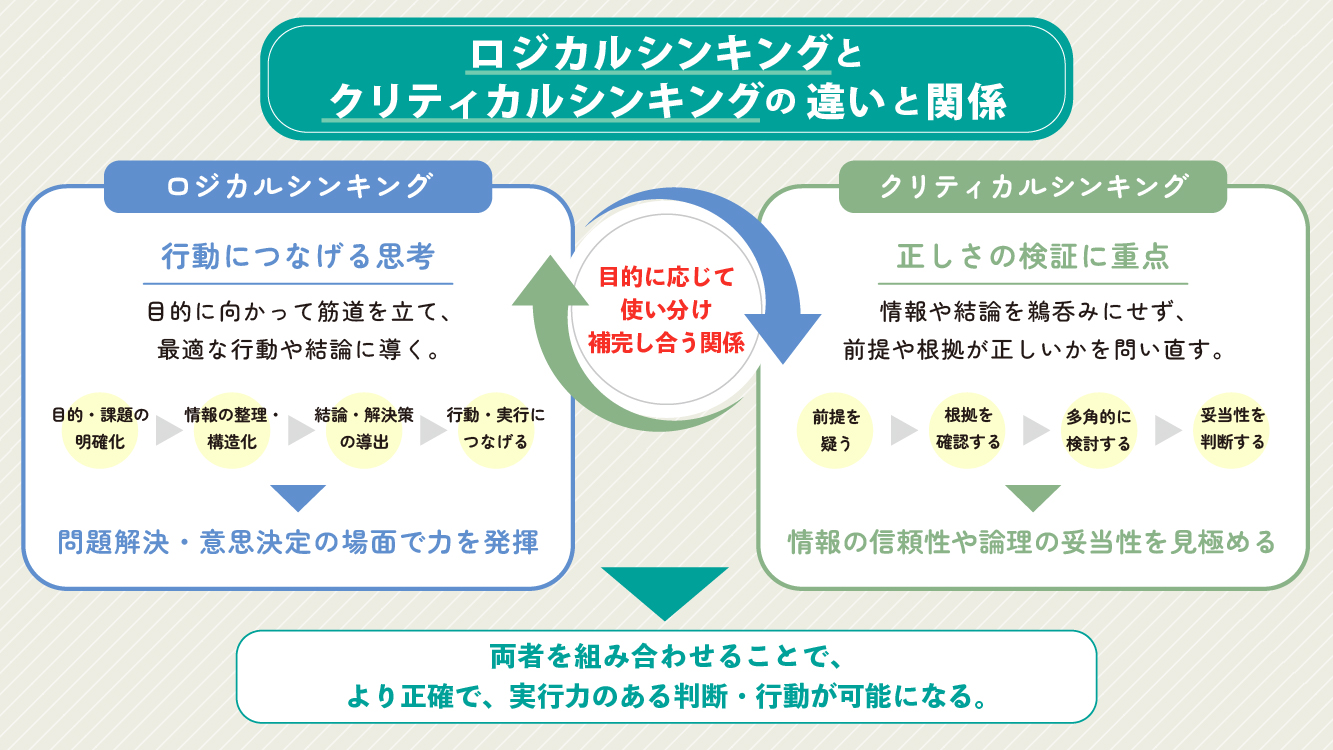
Here, we explain the differences in actual application scenes while comparing the characteristics of "Logical Thinking" and "Critical Thinking."
● Logical Thinking is the thought process "leading to action"
Logical thinking is a way of thinking that structures reasoning toward a goal and leads to the optimal actions or conclusions. In situations involving problem-solving or decision-making, logical thinking is useful because a structured thought process directly linked to action is required.
●Critical thinking focuses on "verifying correctness"
On the other hand, critical thinking is characterized by an attitude of not taking the information or conclusions in front of you at face value, but rather verifying whether their premises and grounds are correct. It emphasizes questioning "whether the logic holds" more than simply being logical.
●Critical thinking enhances the "accuracy" of logical thinking
Logical thinking is a method of organizing things logically and drawing conclusions, but it is necessary to verify from another perspective whether that logic is based on "correct premises" and "appropriate grounds." This is where critical thinking is required.
Through critical thinking, by removing ambiguities in premises and grounds, the accuracy of conclusions derived from logical thinking is greatly improved. In other words, critical thinking can be said to play an "inspective role" that supports logical thinking.
In other words, logical thinking and critical thinking should be used appropriately according to the purpose, complementing each other. It is important to understand the characteristics of each and use them flexibly.
4. Four Steps to Refine Thinking by Utilizing Logical Thinking and Critical Thinking

In problem-solving, not only "how to think" but also "in what order to think" is very important. By systematically combining logical thinking and critical thinking, it is expected that you can arrive at more accurate conclusions and actionable measures.
Here, we introduce the roles of logical thinking and critical thinking at each step of the thought process, and how to use them appropriately.
〈1. Verifying the Problem〉Examine the problem itself using critical thinking
First, it is important to doubt and verify whether the current "problem" is truly the issue that should be addressed. This is because if the problem is set incorrectly, no matter how logically you think, you will end up heading in a meaningless direction. Here, use critical thinking to check for any biases or errors in the assumptions and current understanding.
〈2. Constructing Ideas〉Implement Logical Thinking
After verifying the validity of the problem, it’s time to apply logical thinking. Organize the cause-and-effect relationships and structurally build your thoughts based on facts. Using frameworks such as logic trees, logically derive the direction of the solution.
〈3. Verification of Results〉Verify the results using critical thinking
Re-examine the derived solutions and hypotheses using critical thinking once again. By reviewing biases in thinking and information gaps, you can notice overlooked risks and alternative possibilities. Conducting verification here significantly improves the accuracy of your thinking.
〈4. Drawing Conclusions and Implementing〉Finding Conclusions and Execution Methods through Logical Thinking
For the final remaining options, use logical thinking to break them down into concrete conclusions and execution steps. Organize logically "how to act" and "how to implement" toward the goal, and connect them to an action plan.
Question the problem (critical thinking), organize it structurally (logical thinking), re-examine the results (critical thinking), and lead to execution (logical thinking).
By being mindful of these four steps, the accuracy and effectiveness of your thinking will improve.
5. How to Improve Organizational and Team Productivity with Critical Thinking
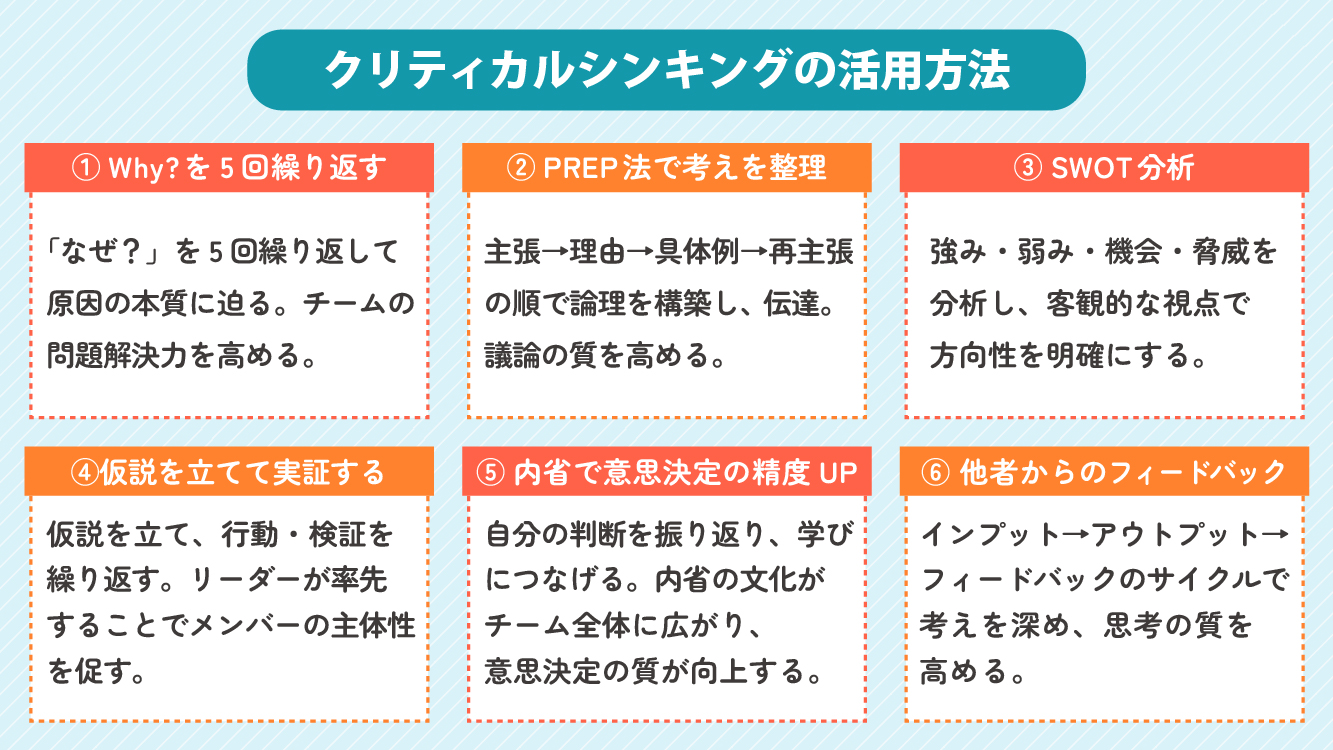
For executives and managers leading organizations or teams, what is required daily is "high-quality decision-making" and "accurate leadership." Supporting these skills is the ability to not take things at face value, to question assumptions, and to see through to the essence—this is critical thinking.
Critical thinking directly impacts not only the individual thinking skills introduced so far but also the problem-solving ability and productivity of the entire team. In this chapter, we will introduce specific ways to utilize critical thinking that lead to improved organizational performance.
〈Application Method.1〉Repeat Why 5 Times (5 Whys)
Instead of jumping straight to the surface problem, repeatedly asking "Why did this happen?" five times helps get to the root cause. Bringing this method into dialogues with team members fosters the entire team's problem-solving ability.
〈Application Method.2〉Organize and Communicate Ideas Using the PREP Method
The PREP method is a framework for constructing logic in the order of "Point → Reason → Example → Point (restated)". By critically organizing your thoughts and clearly conveying them to team members, it enhances the quality of discussions. It also helps speed up decision-making.
〈Application Method.3〉SWOT Analysis
SWOT analysis is a method for calmly reassessing an organization’s or project’s "Strengths, Weaknesses, Opportunities, and Threats." By incorporating a perspective free from biases and emotions, it clarifies the direction the team should take.
〈Application Method.4〉Formulate and Test Hypotheses
The attitude of formulating hypotheses and then acting and verifying them is a key aspect of critical thinking. When supervisors and leaders demonstrate hypothesis-driven thinking themselves, it becomes easier to cultivate a proactive mindset among members to "first try to come up with an idea." As a result, members are more likely to develop the habit of thinking and acting independently.
〈Application Method.5〉Enhance Decision-Making Accuracy through Reflection
When leaders themselves reflect on "why they made this decision" and "whether it was truly the best choice," it sharpens the quality of their thinking and leads to better decisions next time. This also fosters a culture of reflection and relearning throughout the entire team.
〈Application Method.6〉After Input and Output, Receive Feedback from Others
The series of cycles involving exposure to knowledge and cases (input), organizing and expressing them in your own way (output), and then receiving opinions from others (feedback) for reconsideration is ideal for practicing critical thinking.
Critical thinking goes beyond the ability to think; it connects to the ability to lead a team and strengthen an organization. When leaders themselves practice the attitude of questioning, reviewing, and learning, and spread it throughout the entire team, it leads to improved productivity.
6. How to Help Employees Acquire Critical Thinking Skills

In the previous chapter, we explained that critical thinking is effective in improving the productivity of organizations and teams. Here, we introduce practical approaches to help employees acquire critical thinking skills.
〈1〉 Incorporate into training programs and conduct group training and e-learning
First, it is important for employees to understand the basic knowledge, concepts, and benefits of critical thinking. To achieve this, incorporating it into internal training programs is effective. Specifically, learning through group training with discussions, as well as creating an environment where repetitive learning is possible using e-learning, will facilitate smooth penetration throughout all employees.
>Reference blog: What are the effects of e-learning? Key points to improve learning outcomes and precautions after implementation | e-Learning Blog |
<2> Establish rules such as "Ask Why 5 times" and "Provide 3 pieces of evidence" in regular meetings
It is also effective to introduce rules that incorporate critical thinking frameworks into meetings and daily work reports. For example, by establishing rules such as asking "Why" five times to consider the root cause, or always providing three pieces of evidence with proposals, it becomes easier to develop a habit of deeper thinking.
〈3〉 Encourage self-study such as book completion quotas
By establishing a system that encourages finishing books related to critical thinking and sharing impressions, employees can regularly strengthen their “ability to question” and “ability to delve deeper.” It is also a good idea to prepare a recommended reading list or hold book clubs.
〈4〉Supervisors Encourage Critical Thinking on a Daily Basis
It is also important for managers and leaders themselves to set an example. By asking questions such as "What is the basis for that?" or "Are there other perspectives?" in response to subordinates' statements and proposals, they encourage the habit of thinking.
Critical thinking is not a skill that can be acquired overnight. Continuous learning and practice, as well as fostering a culture of thinking throughout the entire organization, are essential.
7. Summary

To establish critical thinking among employees, it is important to create continuous learning opportunities alongside practical experiences.
Human Science's e-learning material, "– Critical Thinking for Young and Mid-Level Employees –," is composed of content that is applicable across industries and can be easily used starting from one person for one month. Additionally, it can be customized for your company, making it easy to implement and allowing for more practical content. It also includes a pre-course awareness survey sheet and a post-course comprehension test, which makes it attractive by enabling visualization of learners' progress.
By utilizing such materials and combining them with the practical approaches explained in Chapter 6, employees’ thinking abilities will be established not just as knowledge but as practical skills.
Critical thinking is an indispensable skill for business professionals going forward.
Why not start by improving your skills with easily accessible e-learning?
You can also check the details of the services on Human Science's e-learning site.
>Reference Link: – Critical Thinking for Young and Mid-Level Employees –

Supervisor Information