








2026.06.12
e-Learning is Recommended for Critical Thinking Training! Strengthening the Thinking Skills of Young and Mid-Level Employees

-
Category
Recommended Articles
-
What is Vyond? Introducing the benefits of an animation video production tool that can be used for business.
-
[Animation Teaching Material Production] How to Create e-Learning Materials ②
-
How does Vyond differ from other animation production software? Comparison and recommendations
-
Can Vyond animations be used as teaching materials? Here are the benefits of using them in e-learning and training.
-
Let's create business animations with Vyond! An explanation of the reasons and benefits recommended for business, as well as challenges.
-
Vyond Go (AI Video Generation) Tips and Best Practices ① Vyond Go Setup Guidelines
-
Moodle Basic Course: What is Moodle?
-
[Moodle Basic Course] What can the e-learning management system Moodle do?
-
[Moodle Basic Course] What can be done with Moodle's default features
-
Benefits and Considerations of Moodle Cloud Services
-
Moodle is not only used by universities (widespread use)



In an era where the pace of change is rapid and there is not just one "correct answer," what is required of young to mid-level employees is not to accept given information as is, but to think for themselves, make judgments, and derive the optimal answer through the power of "critical thinking."
This article provides a comprehensive explanation of the purpose and target audience of critical thinking training, the main training content, effective methods, and key points for selecting a program. Additionally, it introduces e-learning materials that busy business professionals can efficiently study.
Table of Contents
1. What is Critical Thinking Training? What are the Training Objectives and Ideal Participants?
2. Main Content of Critical Thinking Training
3. Recommended Methods for Critical Thinking Training
4. How to Choose Critical Thinking Training
5. Introduction to Human Science's "Critical Thinking" e-Learning Materials
6. Summary
1. What is Critical Thinking Training? What are the Training Objectives and Ideal Participants?

Let's first grasp the basics of what critical thinking training entails.
〈What is Critical Thinking Training?〉
Critical thinking is a way of thinking that involves not accepting information or issues at face value, but rather approaching them with a critical perspective to objectively, multifacetedly, and rationally understand and judge matters. Critical thinking training systematically cultivates this ability.
Its purpose is to enhance the skills needed to carry out tasks while solving the business challenges faced daily. Critical thinking is also directly linked to creating persuasive proposals and constructing presentations that are convincing.
<Difference from Logical Thinking>
While logical thinking emphasizes the ability to think in a structured and coherent manner, critical thinking focuses on questioning assumptions and information to arrive at more reasonable conclusions. Although they are different, they complement each other, and in business settings, skillfully balancing both leads to persuasive and effective decisions and proposals.
<Purpose of Critical Thinking Training>
Through the training, participants acquire logical thinking skills, problem-solving abilities, decision-making capabilities, and communication skills that persuade others. When each employee masters these skills, it not only improves individual performance but also leads to increased productivity across the entire company.
〈Ideal Participants for Critical Thinking Training〉
It is especially effective for young and mid-level employees. Young employees can be expected to grow from simply "carrying out" assigned tasks to "thinking through and advancing" them by solidifying their thinking foundation. On the other hand, mid-level employees, who lead teams, require strengthened judgment and persuasion skills, so the training's effects directly contribute to business results.
In this way, critical thinking training can be said to be a place where young and mid-level employees hone their "thinking skills" to grow as the core of the organization.
2. Main Contents of Critical Thinking Training
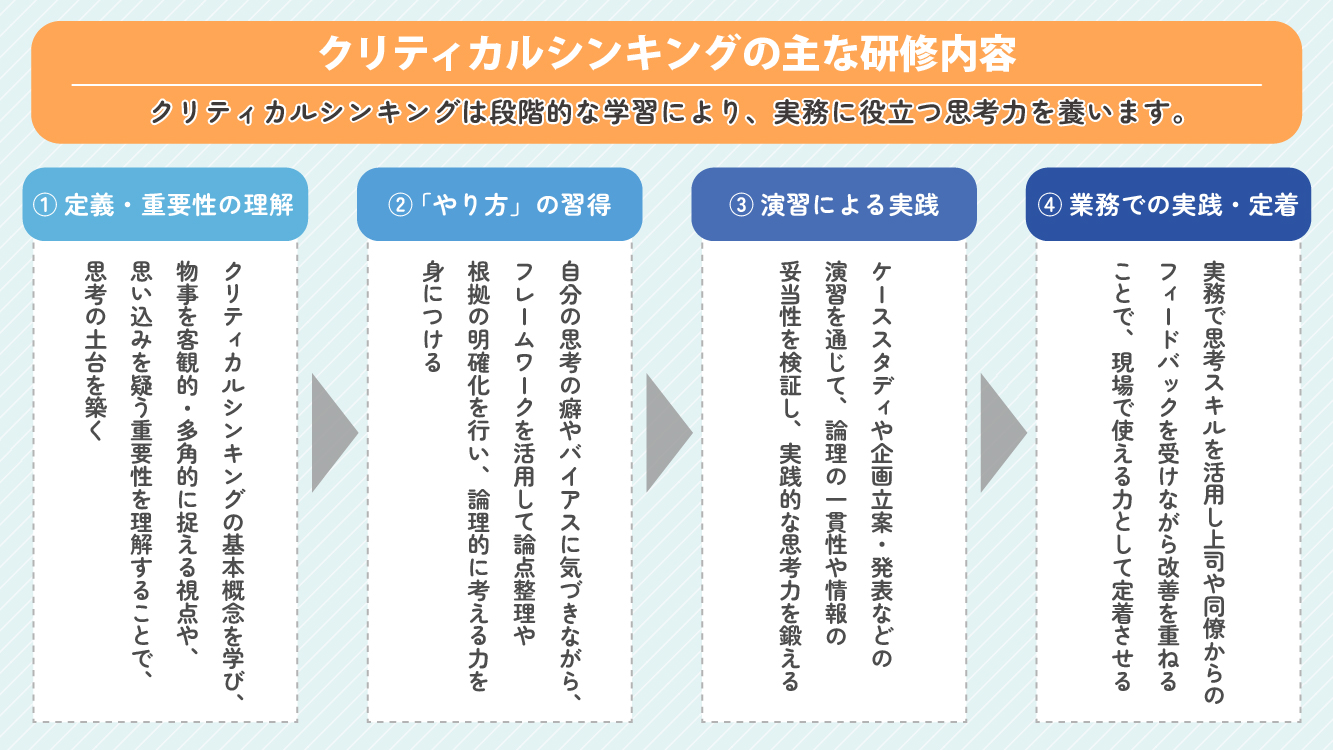
Critical thinking cannot be acquired by simply "knowing the knowledge." In the training, participants develop practical thinking skills by learning step-by-step—from understanding basic definitions to practical exercises and applying them to daily work. This chapter explains the main contents of critical thinking training.
〈Training Content.1〉Definition and Importance of Critical Thinking
It begins with correctly understanding "What is critical thinking?" You learn the importance of objectively and multi-facetedly grasping information, questioning assumptions and biases, and logically deriving conclusions. Through this, learners can realize the "value and necessity of critical thinking" and deepen their understanding.
〈Training Content.2〉How to Practice Critical Thinking
Next, you will learn the specific process of thinking. To acquire critical thinking, it is important to become aware of your own "assumptions" and "thinking habits." Then, using frameworks, you will learn how to organize evidence and apply it to clarify issues and solve problems.
〈Training Content.3〉Critical Thinking Exercises
After acquiring knowledge, participants engage in practical exercises and case studies. For example, through exercises such as planning a proposal for a given issue and delivering a presentation, they hone their ability to verify the consistency of logic and the reliability of information. Additionally, by responding to questions and feedback from others, they develop the attitude of objectively reviewing their own thinking.
〈Training Content.4〉Practice and Feedback in Daily Work
After the training, it is advisable to create opportunities to apply critical thinking in actual work and receive feedback from supervisors and colleagues. By repeating this process, it is expected that the skills learned in the training will be established as "practical abilities usable on the job."
This training structure of "understanding → methodology → practical exercises → actual work" ensures that learning does not end with just acquiring knowledge, but through exercises, participants master critical thinking and further apply it to real work situations.
3. Recommended Methods for Critical Thinking Training

To effectively conduct critical thinking training, not only the content of the training but also "how the training is conducted" is important. Here, we introduce three representative methods and explain their advantages and disadvantages.
〈Method 1〉 e-Learning
◎Merits
e-learning’s major feature is that learners can study at their own pace. It is easy to continue since it can be utilized during spare moments such as while commuting, and learners can study according to their individual level of understanding. Additionally, it is a strong point that it can be easily introduced in companies with remote work or offices nationwide.
●Disadvantages
There are limitations to conducting practical exercises, making it challenging to provide opportunities for immediate output of the acquired knowledge. Additionally, it is difficult to ask questions to instructors or staff on the spot, which can leave some learners uncertain about their understanding.
<Method.2> In-House Training
◎Merits
In-house training is attractive because it allows practical learning by incorporating workshops and group discussions. Compared to outsourcing, it can reduce costs, and it is also advantageous that it can be easily customized to fit the company’s actual work.
●Disadvantages
Since personnel to serve as instructors and preparation for training planning are required, the burden within the company tends to increase. Additionally, if the teaching materials and know-how are limited to the company itself, there is a concern that the scope of learning may become narrow.
〈Method.3〉External Training
◎Merits
Training conducted by external specialized organizations has the advantage of gaining the latest knowledge and practical know-how from expert external instructors. Additionally, there are opportunities to interact with participants from other companies, which also helps broaden perspectives.
●Disadvantages
There is a tendency for costs related to training, such as tuition fees, venue fees, and transportation expenses, to be higher. Additionally, since the training schedule and venue are limited, it is necessary to consider coordinating participants' schedules and work commitments.
As such, each method has its own advantages and disadvantages. By not sticking to just one method and combining approaches—such as using e-learning for knowledge acquisition and in-house training for practical exercises—you can enhance the overall learning effectiveness.
4. How to Choose Critical Thinking Training
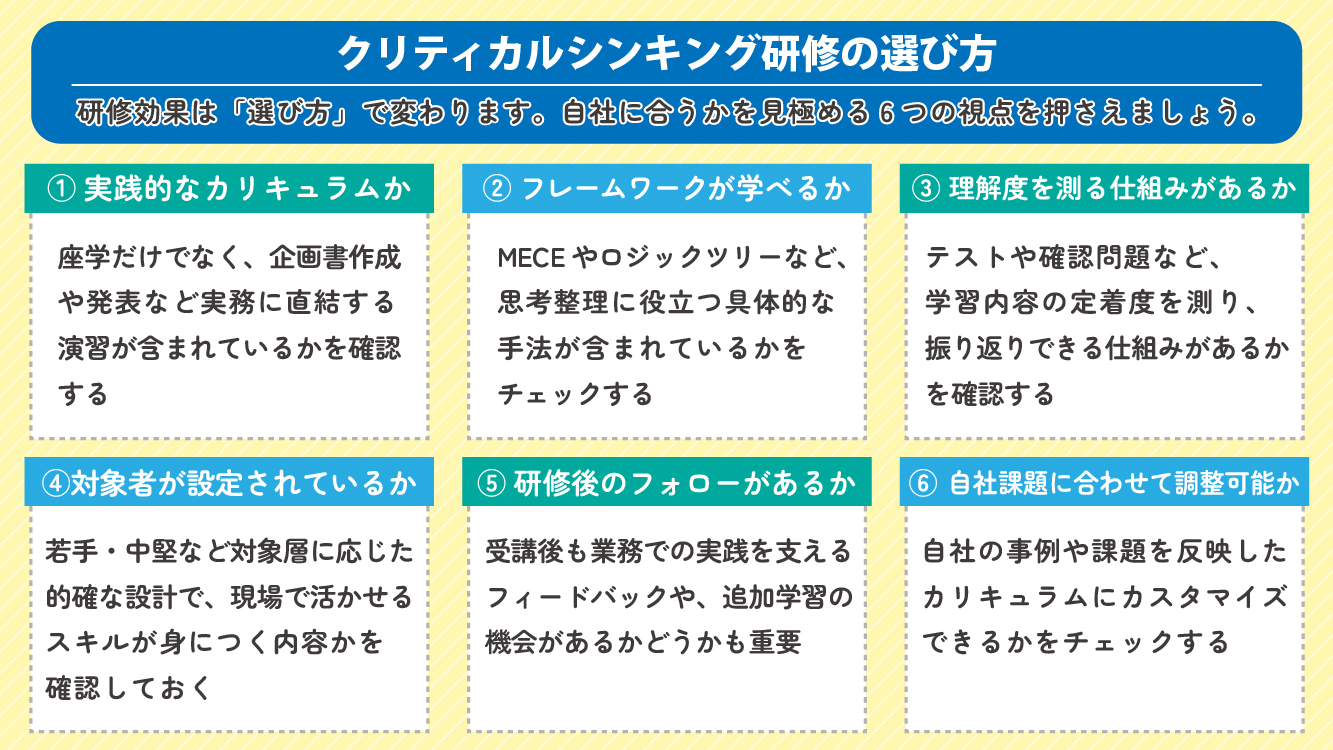
Critical thinking training may not lead to results if the training content and management system do not match your company's challenges or employee demographics. This chapter introduces key points to keep in mind when selecting training materials and training providers.
〈Point 1〉Is the curriculum designed to be applicable in practice?
It is important that the training includes practical exercises directly related to work, such as proposal writing and presentations, rather than being lecture-focused. Having opportunities for output helps develop skills that can be utilized on the job.
〈Point.2〉Is the framework included in the training content?
Check whether frameworks for organizing thoughts, such as MECE (Mutually Exclusive, Collectively Exhaustive) and logic trees, are included in the training. By learning concrete methodologies rather than just understanding concepts, the ability to apply them broadly is enhanced.
〈Point.3〉Is there a comprehension test prepared?
It is reassuring to have a system in place to check how well the learned content has been retained. Having tests or review questions also helps learners reflect on their own understanding.
〈Point.4〉Is the training target, such as young or mid-level employees, clearly defined?
Training programs designed with the target audience in mind tend to have fewer discrepancies with the skills required on the job, making it easier to achieve results. For example, focusing on basic thinking methods for young employees and on decision-making and leadership enhancement for mid-level employees makes the content more applicable in practical work.
〈Point.5〉Is there follow-up after the training?
It is important not only to complete the course but also to have opportunities for feedback and additional learning after applying the skills in the workplace.
〈Point.6〉Can it be customized to your company’s issues?
Some training providers can design curricula that incorporate your company’s specific cases and challenges. Since this leads to more practical and effective training, it is advisable to confirm whether customization is possible before implementation.
5. Introduction to Human Science's "Critical Thinking" e-Learning Materials
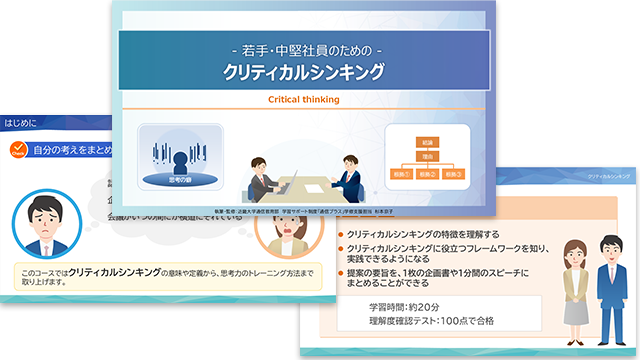
Up to this point, we have explained the purpose, content, and key points for selecting critical thinking training. In this chapter, we will introduce specific materials that can actually be implemented, including the e-learning services provided by Human Science and the "Critical Thinking for Young and Mid-Level Employees" materials.
●Advantages of Human Science's Teaching Materials
・Freely use what your company needs from 7 selectable themes
・Various training themes provided via cloud service
・Easy customization to fit your company’s regulations and cases due to PowerPoint format materials
・Available per one material for one month, with no restrictions on number of users or duration
・Supports English, Chinese, Thai, etc., providing peace of mind for companies with global operations
These features make it possible to implement training optimized for your company while keeping costs down.
To master critical thinking, we especially recommend the "Critical Thinking for Young and Mid-Level Employees" training material.
● Benefits of the "Critical Thinking for Young and Mid-Level Employees" Training Material
・Approaches the challenges faced by young and mid-level employees in their work, leading to strengthened practical skills on the job
・Facilitates learning retention through a continuous flow from awareness surveys to study and practice
・Introduces frameworks useful for critical thinking, connecting knowledge to practical application
・Visualizes learning outcomes through comprehension checks via tests
The materials provided by Human Science are designed to be immediately applicable to work after training, helping young employees solidify their foundational skills and mid-level employees enhance their thinking skills to lead teams.
You can check the details of the materials and services from the links below.
>"Critical Thinking for Young and Mid-Level Employees"
>e-Training / Teaching Material Sales Service
6. Summary

In highly uncertain business environments, what is required of young and mid-level employees is "critical thinking," which means not taking information at face value, thinking from multiple perspectives, and leading to a convincing conclusion.
Through critical thinking training, acquiring problem-solving skills and persuasive communication is expected to greatly improve the quality and results of daily work.
Referring to the training content, methods, and selection criteria explained in this article, why not introduce a program that fits your company and promote the creation of an organization where employees can think and act proactively?
If you have any questions or concerns regarding the implementation, please feel free to contact Human Science.
Supervisor Information