







2026.09.02
What Are Open Badges? An Easy-to-Understand Explanation of the Digital Certification System, Implementation Methods, and Use Cases

-
Category
Recommended Articles
-
What is Vyond? Introducing the benefits of an animation video production tool that can be used for business.
-
[Animation Teaching Material Production] How to Create e-Learning Materials ②
-
How does Vyond differ from other animation production software? Comparison and recommendations
-
Can Vyond animations be used as teaching materials? Here are the benefits of using them in e-learning and training.
-
Let's create business animations with Vyond! An explanation of the reasons and benefits recommended for business, as well as challenges.
-
Vyond Go (AI Video Generation) Tips and Best Practices ① Vyond Go Setup Guidelines
-
Moodle Basic Course: What is Moodle?
-
[Moodle Basic Course] What can the e-learning management system Moodle do?
-
[Moodle Basic Course] What can be done with Moodle's default features
-
Benefits and Considerations of Moodle Cloud Services
-
Moodle is not only used by universities (widespread use)



There is an increasing number of organizations facing the challenge of objectively proving learners' skills and training achievements and improving the accuracy of skill management. Some organizations issue paper certificates to represent skills and certifications, but managing them is complicated and there is a risk of loss. Without physical certificates, it has been difficult to clearly see "what skills a person possesses."
The mechanism attracting attention as a solution to this issue is the "Open Badge." Open Badges are digital credentials based on international technical standards, making them difficult to forge, verifiable with a single click for authenticity, and easy to share on social media or resumes. When integrated with an LMS (Learning Management System), they can be automatically issued upon completion of training, enabling efficient management. Their adoption is expanding in Japan among government agencies, universities, and companies.
This article comprehensively explains everything those involved in education and training need to know, from the basics of open badges to implementation methods using LMS and global case studies.
>Related Blog: What is Totara Learn? Introduction to Features and Use Cases of the LMS
Table of Contents
1. Basic Knowledge of Open Badges
1-1. What is an Open Badge?
1-2. Status of Open Badge Adoption Worldwide and in Japan
1-3. Use Cases of Open Badges
1-4. Benefits of Introducing Open Badges
2. How to Implement Open Badges
3. Open Badge-Compatible LMS "Totara"
3-1. What is Totara? Features of an Open Badge-Compatible LMS
3-2. Open Badges Issued by Totara
4. Case Studies of Open Badges Using Totara
4-1. SHIMANO | Certifying External Mechanics with Digital Badges
4-2. The Law Society | Demonstrating Expertise with Microcredentials and Badges
5. Summary | For Introducing and Utilizing Open Badges, Choose Totara
1. Basic Knowledge of Open Badges
1-1. What is an Open Badge?
An Open Badge is a "digital credential" issued according to international technical standards. It proves when, who, and what kind of learning or activities were undertaken, and which criteria were met, and can be easily shared with third parties via email or websites.
Unlike traditional paper certificates or PDF qualification proofs, open badges have the characteristic of being "tamper-proof" as digital data, and their authenticity can be verified with a single click, which is a major feature.
1-2. Status of Open Badge Adoption Worldwide and in Japan
The use of Open Badges is rapidly advancing worldwide. According to a survey by the 1EdTech Consortium, which sets international standards (※), the number of badges awarded is expected to increase approximately 13-fold, from 24.1 million in 2018 to 320.4 million in 2025, indicating the widespread adoption of skill certification utilizing Open Badges.
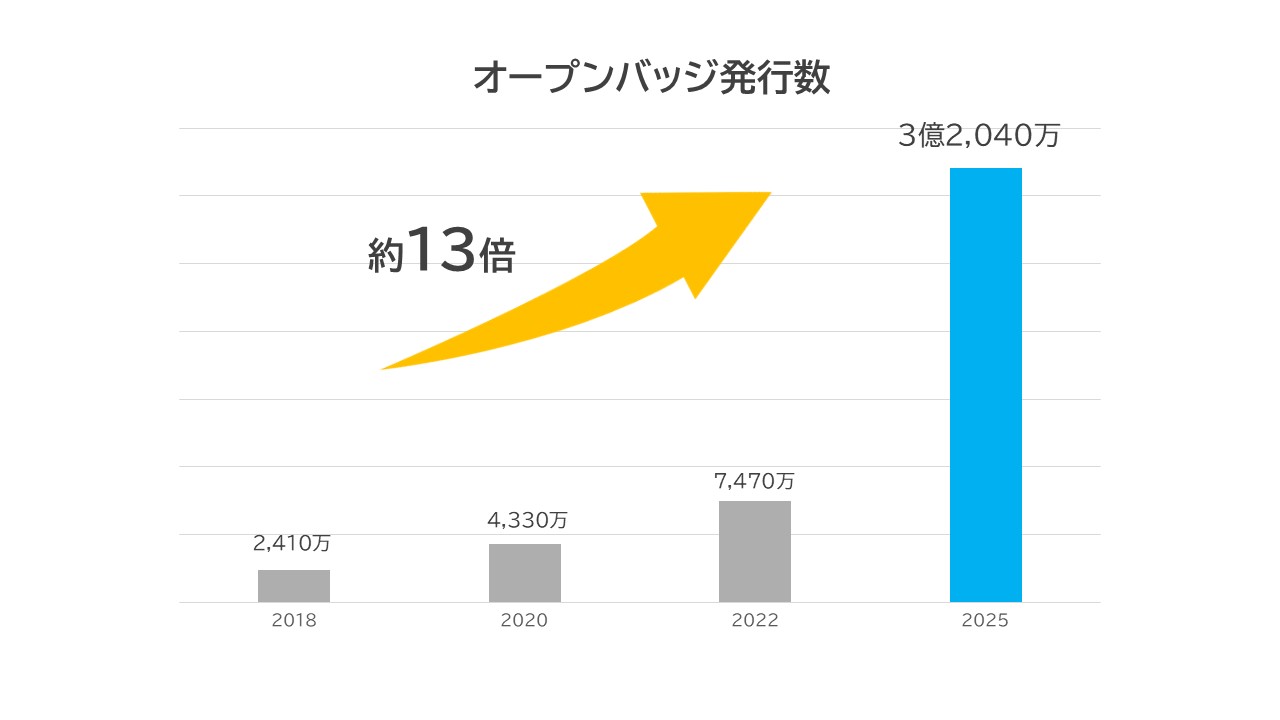
*Created by Human Science based on publicly available materials from 1EdTech and Credential Engine.
(https://content.1edtech.org/badge-count-2025/results)
On the other hand, the adoption of Open Badges within Japan is still in a developing stage compared to the rapid growth seen worldwide. In recent years, government agencies have also begun implementing them, such as the Digital Agency issuing and awarding Open Badges utilizing blockchain technology when appointing digital promotion commissioners, and further expansion is expected in the future.
1-3. Use Cases of Open Badges
Open badges are becoming widespread across a wide range of fields including education, business, and social activities. Thanks to digital technology, it has become possible to prove learning and contributions that were previously difficult to visualize, evolving into an important system that supports individual career development. Specifically, they are utilized in the following situations.
・Use in Educational Institutions
At universities, vocational schools, and other institutions, the adoption of open badges is progressing as a means to record and verify diverse learning achievements that traditional transcripts and diplomas could not fully convey. Beyond simply completing courses, a major feature is that open badges can specifically demonstrate "what and how something was learned," such as acquiring particular skills or completing off-campus practical training and internships. Hiring managers can refer to the badge metadata to review evaluation criteria and learning content in detail, making it a more transparent and trusted source of information than conventional certification.
・Utilization in Companies
There is a growing trend to visualize employees' skills and achievements as an internal certification system, such as completion of in-house training, obtaining qualifications, and contributions to projects. By clarifying "what kind of specialized skills the personnel possess" through badges, it can be used for optimal personnel placement and career development. Additionally, from the perspective of lifelong learning, it is also noteworthy that proof of skills accumulated during employment can be carried in a form that is recognized outside the company.
Open Badges are also used to record and verify achievements in all kinds of learning environments, such as issuing badges for participation in workshops and events.
1-4. Benefits of Implementing Open Badges

What are the benefits of utilizing Open Badges? Traditional paper certificates had issues such as the burden of skill management, risk of loss, and difficulty in career promotion. The advantages of using Open Badges are as follows.
・Improved Accuracy in Talent Utilization through Skill Visualization
Acquired skills are clearly visualized, allowing skill holders to be searched within the system. When assigning or transferring personnel, it becomes possible to quickly identify individuals with the necessary skills, thereby improving the accuracy of talent utilization. Thanks to blockchain technology, which makes forgery and tampering virtually impossible, the reliability of qualification verification is also ensured.
・Showcasing Learning Achievements and Improving Learning Continuation Rates
Earned badges can be easily attached to social media, resumes, email signatures, and more, serving as a means to externally demonstrate one’s learning achievements. Having tangible proof of accomplishments creates a sense that “what I have learned is being recognized,” which helps maintain and boost motivation to continue learning. Additionally, badges can be used as certification credentials, providing a significant advantage by directly supporting career development even when changing organizations.
・Reduction of Management Burden and Elimination of Loss Risk
Issuing organizations can reduce the effort involved in issuing and managing paper certificates, eliminating printing and mailing costs. For learners, unlike paper certificates, there is no risk of loss, and badges issued by multiple organizations can be centrally managed in a digital wallet. This allows for the secure accumulation of lifelong learning records.
2. How to Implement Open Badges
To issue Open Badges, a system compliant with international standards (Open Badges specification) is required. Here, using an LMS capable of issuing Open Badges as an example, let's look at the process leading up to implementation.
・Step 1: Determine the Purpose of Implementation and Target Audience
Identify which training sessions or courses will issue badges, and understand the number and attributes of the target participants. Decide the issuing department and organize the division of roles within the organization.
・Step 2: Setting Up the Badge Function in the LMS
Enable the Open Badge feature in the LMS and register issuer information (such as organization name and contact details). Set which course completion will trigger badge issuance.
・Step 3: Badge Design and Metadata Planning
Create the badge image and organize metadata such as the badge name, description, acquisition requirements, skills acquired, and usage scenarios.
・Step 4: Registration in the System
Register the created badge image and metadata in the system, and set an expiration date if necessary.
・Step 5: Issuance and Receipt Procedures
When the learner meets the completion requirements, the system automatically sends a notification email for badge awarding. The recipient can register the badge in their wallet simply by clicking the link, with no individual handling required by the administrator.
3. Open Badge-Compatible LMS "Totara"
To issue open badges, a system that complies with international standards is required. What kind of system specifically issues open badges? Here, we introduce the LMS "Totara," which comes standard with open badge functionality and is implemented by organizations worldwide.
3-1. What is Totara? Features of an LMS Supporting Open Badges
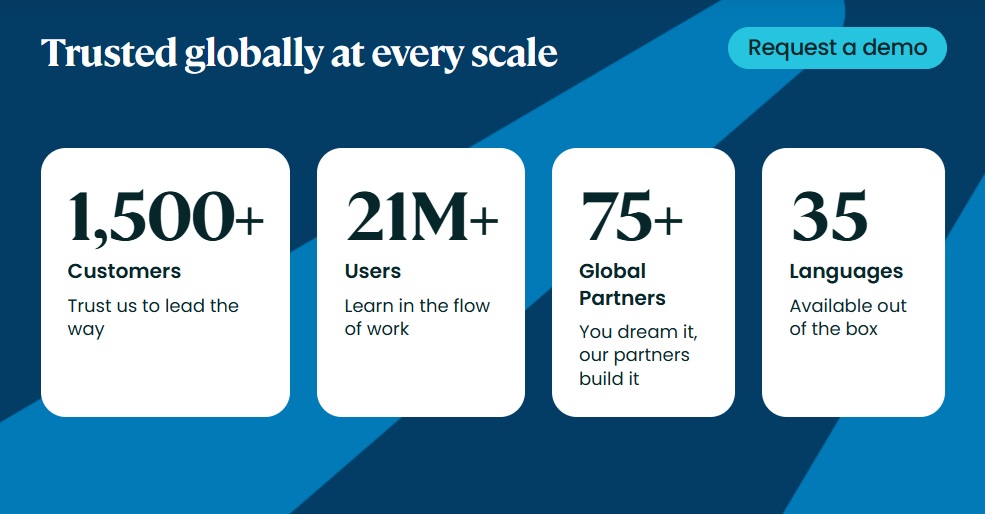
Totara is a platform optimized for companies and organizations, based on the open-source LMS "Moodle," which is used by educational institutions worldwide. Totara integrates essential functions for organizational management, performance management, and talent development, including the issuance and management of open badges.
Developed in New Zealand, Totara is currently adopted by major corporations, government agencies, NGOs, and other organizations around the world, and has received high acclaim, including being selected for 12 consecutive years as one of Training Industry's "Top 20 LMS Companies."
3-2. Open Badges Issued by Totara
Totara supports Open Badges 2.0. There are two types of badges that can be issued.
・Site Badge
Available to all users within the site, awarded based on system-level activities or criteria (such as program completion or adding profile information).
・Course Badge
Available to users enrolled in the course, these badges are awarded for actions such as completing activities within the course or finishing the course itself.
Earned badges are displayed in a list on the user’s profile page and can be viewed at any time. Since they are also visible to other users, this helps visualize learning achievements within the organization and fosters a sense of competition among learners, which is expected to boost motivation for continuous learning. Additionally, badge images can be downloaded and posted on social media platforms like LinkedIn, or registered on badge platforms such as Credly for centralized management.
▽Examples of Badges Issued with Totara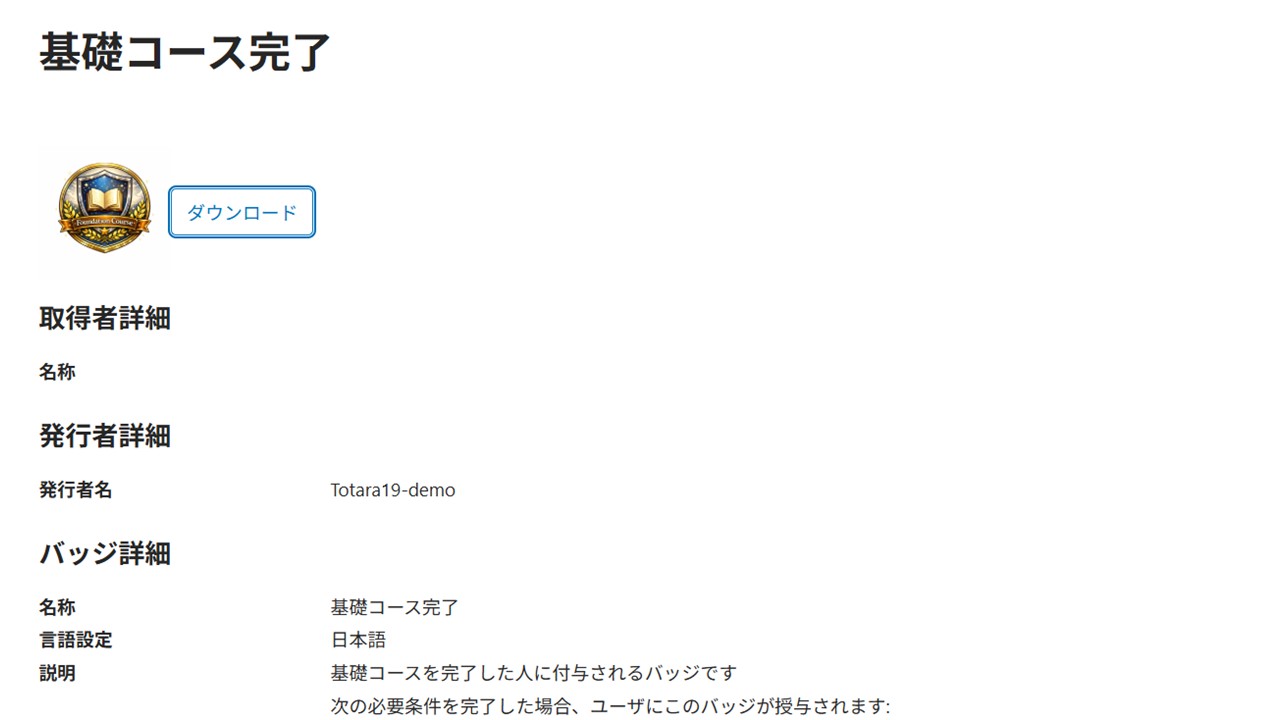
4. Case Studies of Open Badge Utilization Using Totara
From here, we will introduce case studies of companies operating globally that utilize open badges with Totara.
4-1. SHIMANO|Certifying External Mechanics with Digital Badges
Shimano Europe, a bicycle component manufacturer, needed to provide knowledge acquisition and certification of their products to mechanics working at independent service centers across Europe. However, since the mechanics were not Shimano employees, the traditional approach centered on distributing paper manuals, and there was no system to continuously deliver the latest product knowledge.
To address this challenge, they built a multilingual digital learning platform using Totara. Mechanics who complete the program can earn an open badge, which objectively proves that they meet Shimano’s established service standards. By awarding badges to individuals, mechanics can carry proof of their skills with them even if they change jobs or transfer. To date, over 5,000 badges have been awarded, and approximately 170,000 course completions have been recorded.
>https://www.totara.com/customer-stories/shimano/
4-2. The Law Society|Proving Expertise with Microcredentials and Badges
The Law Society, a UK professional body for legal practitioners with approximately 155,000 members, faced challenges as their traditional in-person seminars and outdated platform could not accommodate the diverse career stages and fields of work, nor provide an environment where members could learn flexibly amidst their practical duties.
To address this, they built a digital learning platform using Totara and introduced micro-credentials (short-term intensive specialized skill certification programs). Digital badges are issued to those who complete the programs, which are utilized for external qualification proof and career promotion.
* This case study is a summary of the Totara official customer story linked above and the content of the Totara Community Webinar video.
5. Summary|For Implementing and Utilizing Open Badges, Choose Totara
Open badges are rapidly spreading worldwide and in Japan as a digital certification system that simultaneously achieves skill visualization, increased motivation to learn, reduced management costs, and ensured reliability of certification. Totara is an LMS equipped with a standard badge issuance feature that complies with international standards (Open Badges specification).
If you are considering the introduction and operation of open badges, please consider Totara. Human Science, the only Totara partner in Japan, will fully support you from implementation to operation.
>Service Site: LMS & LXP Implementation ~ Totara Learn ~ For Corporate Human Resource Development
About the Author