







2024.03.22
2026.06.29
What are the key success points for conducting information security training with e-learning? Introducing implementation steps and how to choose teaching materials

-
Category
Recommended Articles
-
What is Vyond? Introducing the benefits of an animation video production tool that can be used for business.
-
[Animation Teaching Material Production] How to Create e-Learning Materials ②
-
How does Vyond differ from other animation production software? Comparison and recommendations
-
Can Vyond animations be used as teaching materials? Here are the benefits of using them in e-learning and training.
-
Let's create business animations with Vyond! An explanation of the reasons and benefits recommended for business, as well as challenges.
-
Vyond Go (AI Video Generation) Tips and Best Practices ① Vyond Go Setup Guidelines
-
Moodle Basic Course: What is Moodle?
-
[Moodle Basic Course] What can the e-learning management system Moodle do?
-
[Moodle Basic Course] What can be done with Moodle's default features
-
Benefits and Considerations of Moodle Cloud Services
-
Moodle is not only used by universities (widespread use)



In modern society, the importance of information security is increasing. For companies and organizations to avoid risks such as information leaks and cyber attacks, it is essential for each employee to correctly understand information security and take appropriate measures.
One way to meet these needs is through the use of e-learning. However, it is essential that participants correctly understand the material and that the training is beneficial for their actual work.
Therefore, this time, we would like to broadly explain the key success points for conducting information security training with e-learning, as well as the implementation steps and how to choose teaching materials.
Table of Contents
1. What is Information Security Training?
2. Examples of Information Security Training Content via e-Learning
3. How to Conduct Information Security Training Using e-Learning
4. Advantages and Disadvantages of Information Security Training via e-Learning
5. How to Choose e-Learning Materials for Information Security Training
6. Summary
1. What is Information Security Training?

<What is Information Security Training?>
Information security training is a program aimed at enhancing each employee's security literacy to prevent security incidents (accidents related to information security) before they occur. By continuously conducting information security training, it is expected to reduce risks such as information leaks and unauthorized access caused by human error.
〈Background for the Increasing Importance of Information Security Training〉
There are various factors behind companies placing importance on information security training. Here is one example.
(1) Sophistication of Cyber Attacks
Attack methods such as targeted attack emails and phishing scams are increasing and becoming more sophisticated. Therefore, improving the literacy of each employee is essential.
(2) Spread of Telework
With more opportunities to work outside the office, there is a growing need for information management capabilities in more vulnerable environments such as home and public Wi-Fi.
(3) Internal Fraud and Human Error
Risks are increasing that small mistakes or carelessness by employees, such as password reuse or loss of USB drives, could lead to serious information leakage incidents.
(4) Strengthening of Legal Regulations and Guidelines
The number of rules that companies must comply with, such as the Personal Information Protection Law and the My Number system, is increasing, making thorough awareness through education indispensable.
〈Common Methods for Implementing Information Security Education〉
There are several methods for information security education. Here are some typical examples.
(1) Group Training (Face-to-face training)
The advantage is that you can deepen your understanding by interacting directly with the instructor. On the other hand, scheduling and venue arrangements are necessary.
(2) E-learning (Online Course)
You can study regardless of time or place, and it is also suitable for repetitive learning. Since it is delivered in a streaming format, if updated, you can learn with the latest information.
(3) Training Using DVD Materials
While it is easy to watch, the content tends to be fixed and may not provide the latest information.
(4) Participation in External Seminars
Expert insights and the latest information can be easily incorporated, and it also leads to building external networks. Like group training, schedule adjustments are necessary.
Based on these, designing and implementing information security education in the most suitable way for your company leads to effective measures.
* For more detailed explanations about information security education, please refer to the related articles below.
> What is Information Security Education? Introducing Implementation Methods, Steps for Creating Teaching Materials, and How to Create e-Learning Materials!
2. Examples of Content for Information Security Education via e-Learning

Although it is simply called "Information Security Education via e-Learning," there are actually various fields of study and a wide range of materials available. This chapter introduces examples of learning content that can be considered as themes for information security education.
Personal Information Handling and Personal Information Protection Law
Learn appropriate methods and usage for handling personal information, as well as correct disposal methods. Furthermore, deepen your understanding of the overview, purpose, and scope of the Personal Information Protection Act.
Social Media Usage Rules and Risks
Understand the company's social media usage policy and learn the behavior guidelines based on it. Specifically, this includes precautions for information dissemination both internally and externally, appropriate responses to defamation and criticism, and protective measures against unauthorized access to social media accounts, among others.
Compliance
Understand the laws and regulations that companies must comply with, and learn about their importance and impact on society. Additionally, learn about the ethical standards and codes of conduct that companies uphold, and promote actions based on those principles.
Threats and Countermeasures of Targeted Attack Emails
Learn to understand the attack methods of targeted attack emails, such as sophisticated disguises, links, and attachments, identify suspicious emails, and respond appropriately. Also, understand the procedures for handling and reporting upon receipt, and raise awareness that prompt and calm initial response is crucial.
ID and Password Management
Learn how to create passwords that are difficult to guess, understand their importance, and gain knowledge on how to deal with social engineering attacks aimed at stealing passwords, enabling you to manage IDs and passwords safely and appropriately.
Risk of Using Cloud Services
Learn about the risks that may occur when using cloud services, such as data leaks and account hacks, and acquire the knowledge and skills to use them safely.
In information security education, it is also effective to include case studies along with such knowledge. By encountering actual incident cases, learners perceive problems and risks as personal matters and develop a sense of urgency. As a result, their understanding of information security deepens, leading to the acquisition of appropriate response methods and preventive measures.
3. How to Conduct Information Security Training via e-Learning

With the spread of telework and the increasing sophistication of cyberattacks, information security education has become more important than ever. Especially, training using e-learning is attracting attention for its ability to enable efficient learning regardless of time and place. This chapter introduces the specific steps to conduct information security training through e-learning.
〈Step.1〉Clarify the Purpose and Target Audience
First, clarify the purpose of the training and the target audience. The content and depth of the training will differ depending on whether it is for new employees, all employees, or management.
〈Step.2〉Design the Training Content
Next, design the training content according to the purpose. Focus on practical topics that employees can apply in their work, such as preventing information leaks, password management, and precautions for telework environments.
〈Step.3〉Selecting the System
Choose a system to conduct the e-learning. Consider the number of employees taking the course and the necessary features (such as course management and test administration). Additionally, integration with your company’s existing systems and ease of use are also key points in the selection process.
〈Step.4〉Prepare Educational Materials for Information Security Training
There are mainly two methods for educational materials: utilizing existing ones or creating original materials in-house. The differences are as follows:
・Existing materials: Easy to implement and cover a wide range of basic content and general knowledge
・Original materials: Can reflect examples and rules tailored to the company’s operations, leading to more practical learning
〈Step.5〉Establishing the Operational Framework
Clearly define the persons in charge and administrators of the training, and set up a system for checking attendance status and follow-up.
〈Step.6〉Start of Operation
Deliver e-learning according to the training plan and manage attendance status. Setting up reminder notifications and support systems leads to higher participation rates.
〈Step.7〉Effect Measurement and Improvement
After the training, the effectiveness is measured based on comprehension tests, surveys, and subsequent work performance. If necessary, the materials and operational methods are improved and reflected in the next training session.
Information security training through e-learning, by going through these stages, becomes not just about acquiring knowledge but also about changing employees' awareness and behavior, making it more practical.
4. Advantages and Disadvantages of Information Security Training through e-Learning
This chapter organizes the advantages and disadvantages of information security training through e-learning.
Benefits of Learning Information Security through e-Learning
【1】Learn at your own pace regardless of time or place
With e-learning, as long as you have a device and an internet connection, you can study without being restricted by time or location. Learners can progress at their own pace, making use of travel time and spare moments.
【2】You can review as many times as you need until you are satisfied
If there is no specific limit on the number of times you can take the course, e-learning allows repeated participation. Even complex concepts or countermeasures that are difficult to grasp in one go can be thoroughly reviewed through repeated study until fully understood.
[3] High Learning Effectiveness Expected
e-Learning can utilize interactive content and simulations, so high learning effectiveness can be expected. Furthermore, it also leads to acquiring practical information security knowledge.
[4] Easy to Reflect the Latest Information
Compared to paper-based materials such as books, e-learning allows for easier content updates. Therefore, the latest knowledge and countermeasures against threats in the ever-changing field of information security can be updated immediately.
【5】Provides low-cost and uniform education
From the administrator's perspective, e-learning is economical because, unlike group training, it reduces costs such as printing materials, venue fees, and travel expenses for instructors and participants. Additionally, since the same content and materials are provided to all learners, uniform education can be ensured.
Thus, while e-learning is an efficient and flexible method of learning and is effective for studying information security, there are also challenges. Below, we have summarized those challenges and their solutions.

In e-learning, learners need to maintain their own motivation for learning. However, if self-management skills are insufficient, there is a tendency for learning to not progress as planned, leading to a decrease in motivation.

By incorporating fun learning elements such as interactive content and gamification into educational materials, interest in learning increases, and motivation can be maintained.

Information security is a field that requires expertise, so some people struggle with the difficulty of creating e-learning materials.

It is also effective to not produce all materials in-house, but to purchase existing content or to request material production from vendors (sales companies) that provide e-learning materials. By enlisting the help of professionals with specialized knowledge, you can create high-quality materials.

In e-learning, unlike group training, it can be difficult to engage in dialogue and discussions with others, which may lead some individuals to feel isolated. As a result, there can be a decline in motivation and stagnation in learning.

By utilizing discussion forums and online chats, active interaction between learners and instructors will promote the resolution of questions and the sharing of information, leading to deeper learning.
By appropriately incorporating solutions to these challenges, the weaknesses of e-learning can be covered, leading to improved learning outcomes and increased motivation among participants.
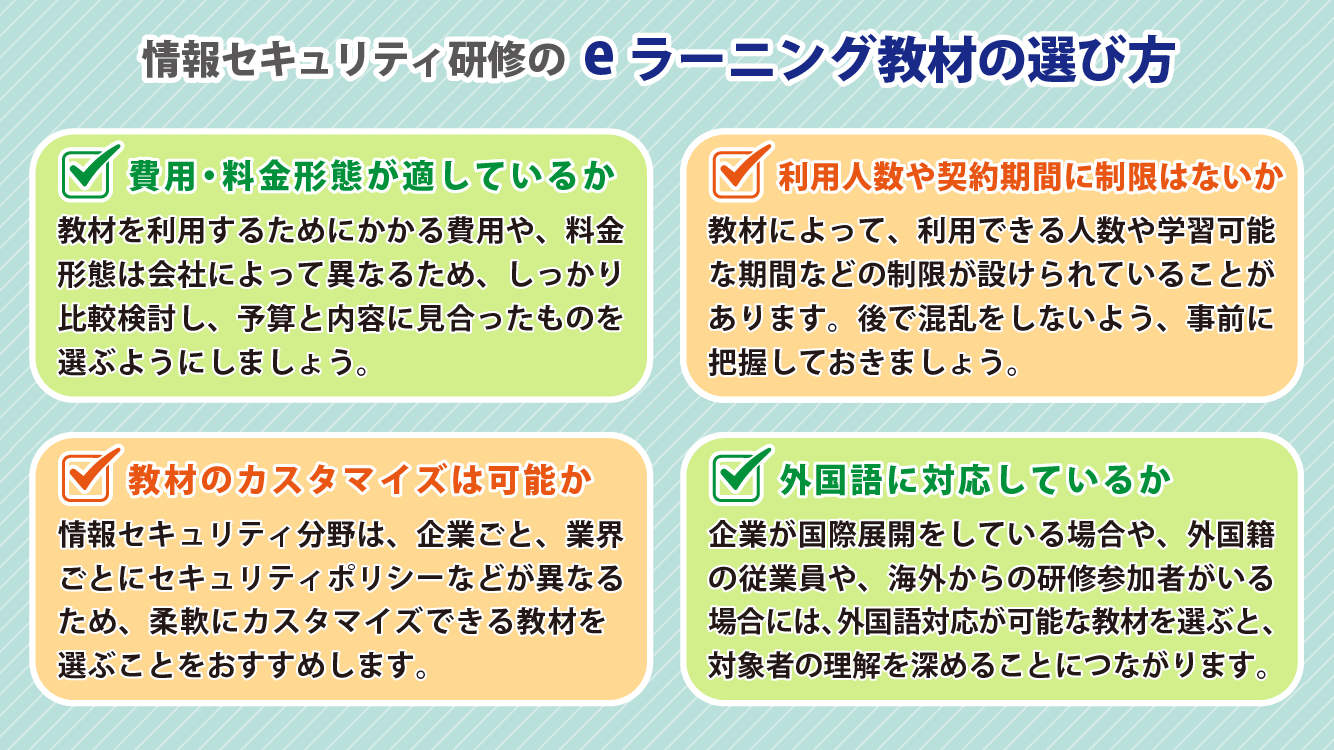
5. How to Choose e-Learning Materials for Information Security Training
Choosing the right materials is also important for successfully conducting information security training using e-learning. Here are some key points to keep in mind when selecting materials.
Is the cost and pricing structure appropriate?
The costs associated with using teaching materials vary depending on the provider. Additionally, pricing structures differ widely, ranging from free options to one-time purchase models with only an initial fee, subscription models with monthly fees, and pay-per-use charges for each time the material is accessed. When implementing, be sure to compare and consider each material carefully and select one that fits your budget and content requirements.
Are there any restrictions on the number of users or the contract period?
Some teaching materials may have restrictions on the number of users or the period during which learning is possible. By planning and understanding the number of participants and the usage period in advance, you can prevent confusion and avoid unnecessary expenses.
Can the teaching materials be customized?
Teaching materials are divided into those that are used as provided by the supplying company and those that are customized for use within the company. In the field of information security, since security policies and required know-how differ by company and industry, it is recommended to choose materials that can be flexibly customized.
Is it compatible with foreign languages?
When a company is expanding internationally or has foreign employees or training participants from abroad, it is important to choose materials that are available in foreign languages. Learning in one's native language can deepen understanding and improve learning effectiveness.
We recommend selecting materials that match the training objectives and the needs of the participants while considering these points.
6. Summary

To deepen the understanding of the constantly changing field of information security, it is essential to have up-to-date materials that reflect the latest information and a flexible learning environment. E-learning equipped with these elements can be considered the optimal learning tool.
To maximize the learning effectiveness of such e-learning, the "quality of the materials" is crucial.
As we have seen, there are various types of materials and many ways to use them. Since free trials may be available, actively utilize them to carefully evaluate ease of use, cost performance, and whether they meet your company's needs, and choose wisely.
Human Science offers a wide range of educational materials related to information security.
These include content focused on devices such as personal computers and smartphones, as well as materials specialized for telework and remote work. Each theme covers essential knowledge, and interactive elements like quizzes are also incorporated.
We also offer a free trial, so if you are considering it, please feel free to try it out.
Please refer to Human Science Co., Ltd.'s e-learning site.
Supervisor Information