







2024.05.24
2026.07.15
Mandatory Measures to Prevent Maternity Harassment! Explanation from Background and Causes to Measures Companies Should Take and the Benefits of Training!

-
Category
Recommended Articles
-
What is Vyond? Introducing the benefits of an animation video production tool that can be used for business.
-
[Animation Teaching Material Production] How to Create e-Learning Materials ②
-
How does Vyond differ from other animation production software? Comparison and recommendations
-
Can Vyond animations be used as teaching materials? Here are the benefits of using them in e-learning and training.
-
Let's create business animations with Vyond! An explanation of the reasons and benefits recommended for business, as well as challenges.
-
Vyond Go (AI Video Generation) Tips and Best Practices ① Vyond Go Setup Guidelines
-
Moodle Basic Course: What is Moodle?
-
[Moodle Basic Course] What can the e-learning management system Moodle do?
-
[Moodle Basic Course] What can be done with Moodle's default features
-
Benefits and Considerations of Moodle Cloud Services
-
Moodle is not only used by universities (widespread use)


One of the important issues in promoting the improvement of the working environment and the advancement of women in society is measures against maternity harassment (hereinafter referred to as Matahara). In Japan, the "Equal Employment Opportunity Law" was revised in 2017, making it mandatory for all companies to take measures to prevent Matahara.
So, what specific measures are necessary? This time, we will focus on maternity harassment, explaining its overview and causes, as well as the responses companies should take and the importance of training.
Table of Contents
1. The Reality and Types of Maternity Harassment
2. Causes of Maternity Harassment
3. Mandatory Maternity Harassment Prevention Measures and Actions Companies Should Take
4. Benefits of Implementing Maternity Harassment Countermeasures
5. The Necessity and Benefits of Conducting Training on Maternity Harassment
6. Summary
1. The Reality and Types of Maternity Harassment
First, let's understand the basics of maternity harassment.
● What is Maternity Harassment?
Maternity Harassment refers to unfair treatment or harassment that female employees experience in the workplace due to pregnancy, childbirth, or the use of parental leave systems.
Let's look at the reality of maternity harassment. According to a survey, 26.3% of female workers who became pregnant or gave birth while employed in the past five years reported experiencing maternity harassment. This means that approximately one in four female employees has experienced maternity harassment.
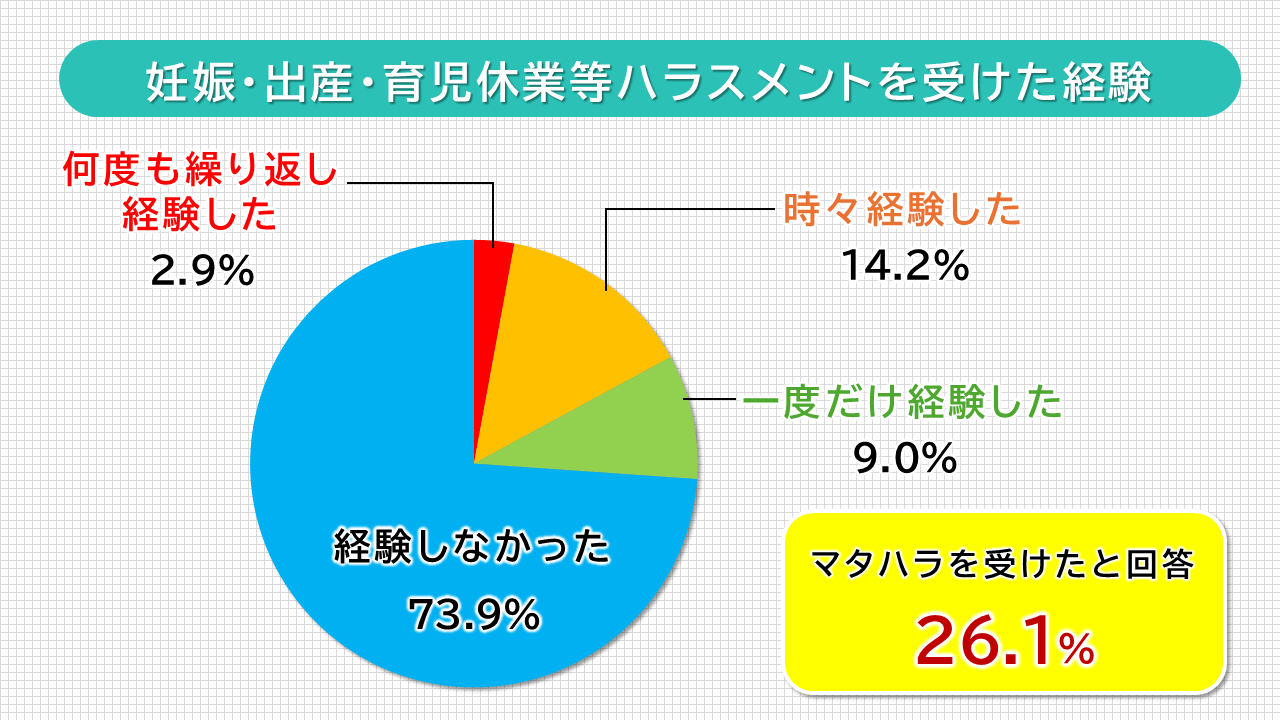
Ministry of Health, Labour and Welfare "Survey on the Actual Situation of Workplace Harassment"
Excerpted and graphed from the 2023 edition report, p.196, Charts 225 and 226
Regarding the actual content of maternity harassment experienced, overall, "Repeated or continuous harassment, etc. (harassing behavior, not allowing engagement in work, assigning only menial tasks)" (21.5%) was the most common, followed by "Behavior by supervisors that requests or obstructs the use of systems, etc." (20.3%). It is also noteworthy that the content of harassment differs depending on the respondents' age groups.
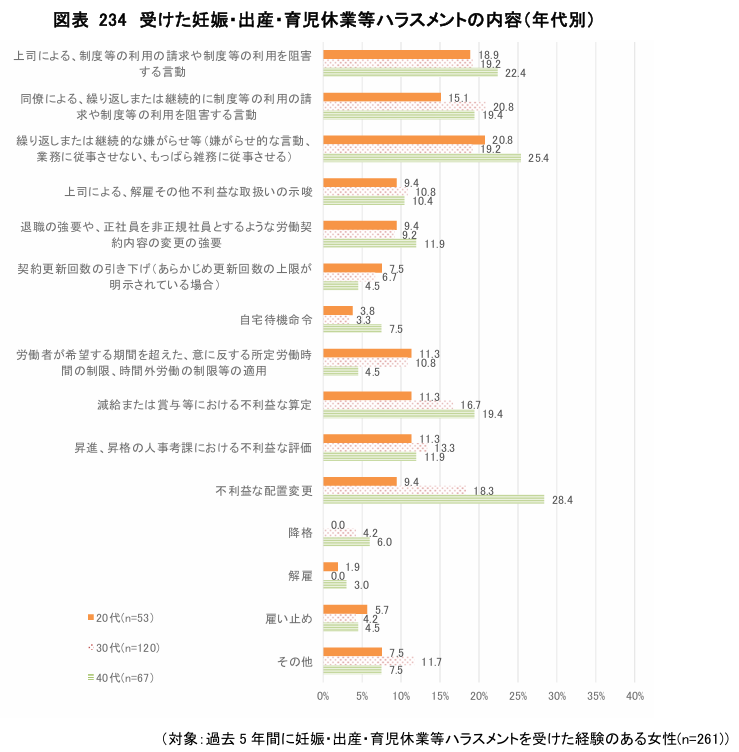
Ministry of Health, Labour and Welfare "Survey on the Actual Conditions of Workplace Harassment"
2023 Edition Report p.201 Chart 234
Such maternity harassment can be divided into two types: "harassment related to the use of maternity and childcare leave systems" and "harassment related to being pregnant or giving birth."
Types of Maternity Harassment.1: Harassment related to the use of maternity and childcare leave systems
Interfering with the use of systems and measures covered by the Equal Employment Opportunity Act and the Child Care and Family Care Leave Act, or harassing workers who utilize them. There are mainly three cases as follows.
(1) Suggestion of Dismissal or Other Disadvantageous Treatment
A supervisor suggesting dismissal or other disadvantageous treatment to employees who request or use the system.
▶ Specifically...
・When I consulted my boss about taking maternity leave, I was told, "If you take leave, you will have to quit."
(2) Requesting or obstructing the use of systems, etc.
Requesting the use of systems or, in the case of employees who use them, having supervisors or colleagues encourage them not to request or use them.
▶Specifically…
・When requesting childcare leave, my boss said, "If you take childcare leave, don't expect to be promoted."
・When requesting childcare leave, a colleague said, "Don't request it because it causes trouble for others."
(3) Harassment Due to Using Systems, etc.
Harassment by supervisors or colleagues against employees who have used systems or similar measures.
▶ Specifically…
・A supervisor said, "We cannot assign major tasks to people who limit overtime work."
・A colleague said, "Everyone is inconvenienced because of your shortened working hours."
Type 2 of Maternity Harassment: Harassment related to pregnancy and childbirth
The work environment is harmed by the words and actions of those around female employees who are pregnant or have given birth. There are mainly two cases.
(1) Suggestion of Dismissal or Other Disadvantageous Treatment
A supervisor suggesting dismissal or other disadvantageous treatment to a female employee who is pregnant or has given birth.
▶ Specifically…
・When reporting her pregnancy to her supervisor, she was told, "We will hire someone to replace you, so it’s better if you resign early."
(2) Harassment Due to Pregnancy or Childbirth
Harassment by supervisors or colleagues against female employees who are pregnant or have given birth.
▶ Specifically…
・A supervisor said, "We can't assign work to pregnant women because we never know when they will take time off," and only gave me menial tasks.
・A colleague said, "If you were going to get pregnant, you should have avoided busy periods."
In addition, cases where male workers become victims are referred to as Paternity Harassment. Paternity Harassment is defined as harassment related to the use of parental leave or childcare leave systems. For example, if a man wishes to take childcare leave but is obstructed from doing so, this constitutes Paternity Harassment.
* The "Childcare and Family Care Leave Act," which is closely related to the issue of maternity harassment, is explained in detail in the blog below.
2. Causes of Maternity Harassment

Maternity harassment in the workplace often occurs even without the intent to harm. Behind this are multiple intertwined factors such as individual awareness, workplace environment, and lack of proper systems. Here, we will organize the main points considered to be the causes of maternity harassment.
Cause 1: Fixed Notion of "Gender Role Division Awareness"
Stereotypes based on gender, such as "Childcare is women's work" or "Work should be scaled back during pregnancy," can unconsciously lead to discriminatory remarks and treatment. These outdated values, even without ill intent from the individual, ultimately foster workplace inequality and become a breeding ground for maternity harassment.
〈Cause.2〉Lack of Knowledge and Experience
Not everyone experiences pregnancy, childbirth, and childcare. Therefore, there are cases where people fail to correctly understand the physical and mental changes or necessary considerations, leading to incorrect judgments or inappropriate remarks. It is also not uncommon for those without proper knowledge to misunderstand and think that "special treatment" is being given.
〈Cause 3〉Lack of Established Systems
In workplaces where parental leave, maternity leave, or shortened working hour systems are not established or not well communicated, there are cases where employees are forced to resign due to pregnancy or childbirth. Additionally, even if such systems exist, if there is an atmosphere that makes them difficult to use in practice, the presence of these systems becomes merely symbolic, ultimately increasing the risk of maternity harassment occurring.
〈Cause 4〉Excessive Consideration
Even actions that appear to be "kindness" or "thoughtfulness" can constitute serious maternity harassment if they involve removing someone from work or distancing them from promotion opportunities without confirming their wishes. Excessive consideration such as "because it seems difficult" or "because we don't want to push them too hard" can ultimately lead to depriving them of career opportunities.
These factors arise from the complex interplay of workplace culture and interpersonal relationships. That is precisely why it is the first step in preventing maternity harassment for companies to repeatedly engage in initiatives to "know, organize, and discuss."
3. Mandatory Measures for Preventing Maternity Harassment and Actions Companies Should Take
● What the Obligation to Implement Maternity Harassment Prevention Measures Means
In recent years, consultations regarding maternity harassment to labor bureaus have been on the rise. In the fiscal year 2015, the number of consultations received by labor bureaus nationwide reached 4,269, a 19% increase compared to the previous year, drawing significant attention as a major issue.
Against this background, in January 2017, it became mandatory for all companies to take measures to prevent maternity harassment due to the revision of the Equal Employment Opportunity Law for Men and Women.
● Measures Companies Should Take to Prevent Maternity Harassment
Along with the obligation to implement maternity harassment prevention measures, the Ministry of Health, Labour and Welfare has provided the following guidelines on the key points of measures companies should take.
(Measure 1) Clarification of the Policy Prohibiting Maternity Harassment and Internal Awareness
Clearly communicate to all employees that maternity harassment is not tolerated. Including specific examples of maternity harassment helps promote understanding. Additionally, revising work regulations to include maternity harassment as a disciplinary cause is also effective.
(Measure 2) Establishment of a system to respond to consultations about maternity harassment and provide appropriate support
It is important to set up a consultation desk for maternity harassment and establish a system that enables the person in charge to respond appropriately according to the content and situation. Furthermore, consultations should be widely accepted not only when maternity harassment has actually occurred but also when there is a risk of occurrence or when it is unclear whether the situation constitutes maternity harassment.
(Measure 3) Appropriate and Prompt Response When Maternity Harassment Occurs
When maternity harassment occurs, the key point is to first conduct hearings with the victim, the perpetrator, and any witnesses to quickly and accurately confirm the facts. Once the facts are confirmed, promptly provide care to the victim. Additionally, take appropriate measures against the perpetrator. Do not forget to implement measures to prevent recurrence.
(Measure 4) Measures to Eliminate the Underlying Causes of Maternity Harassment
As means to eliminate the underlying causes of maternity harassment, organizing the work system and raising awareness of various policies can be cited. Through these measures, smooth communication among employees and the cultivation of an awareness to "perform appropriate work duties" can be fostered, which is expected to prevent the occurrence of maternity harassment in advance. For example, if an employee who is pregnant or has given birth experiences poor health, causing an increased workload for other employees, it is anticipated that harassment such as maternity harassment may occur as a result. Therefore, organizing the system and reviewing the division of work are effective measures against maternity harassment.
(Measure 5) Dissemination of Rules Related to Privacy Protection Concerning Maternity Harassment
Take necessary measures to protect the privacy of those seeking consultation. Specifically, this may include creating manuals on privacy protection and providing training on privacy protection to the staff responsible for handling consultations. It is also important to inform employees that they will not suffer any disadvantages for consulting about maternity harassment or cooperating in investigations of the facts.
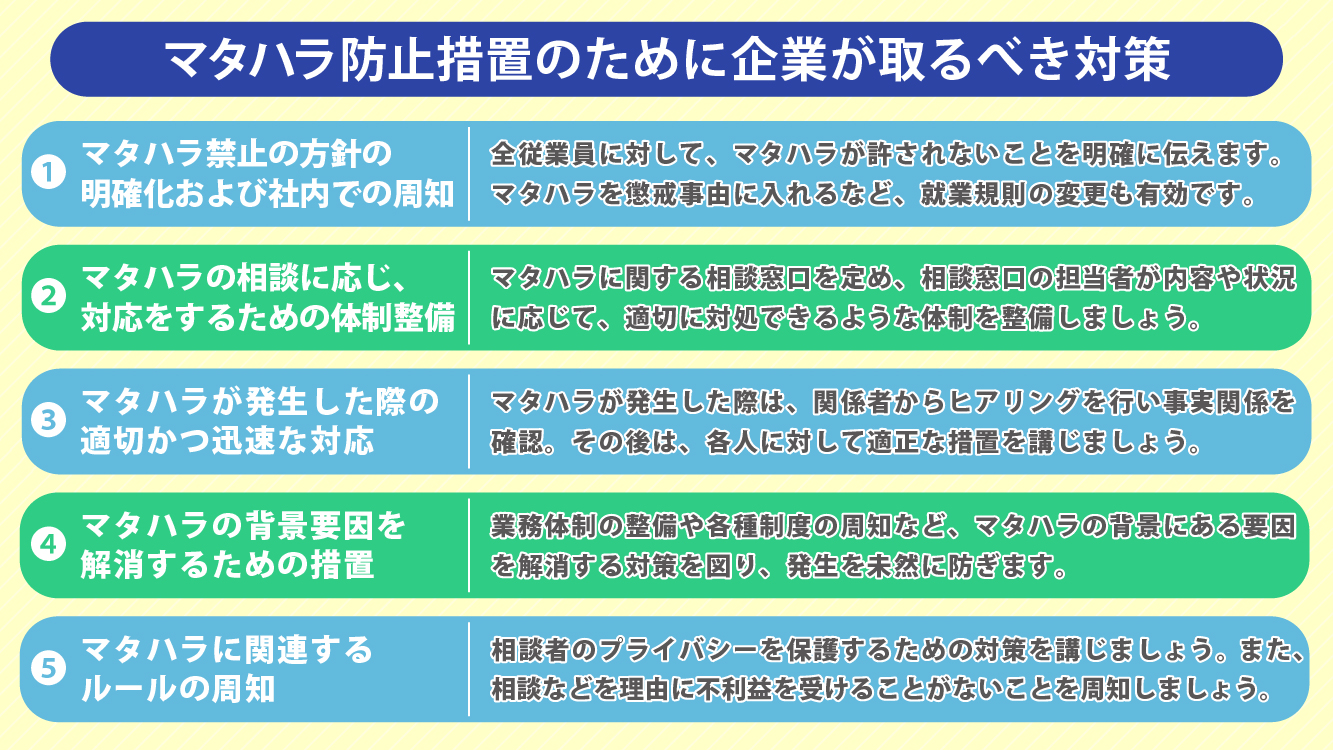
Even if measures for responding to maternity harassment (matahara) are established, if there is no proper consultation system in place, or if employees can consult but there is a risk of information leakage, they will not feel safe to seek advice. Because the problem does not surface, "seeds of matahara" will arise. First, it is necessary to have a consultation window where employees can safely confide their worries and anxieties related to matahara.
4. Benefits of Implementing Measures Against Maternity Harassment

Implementing measures against maternity harassment not only prevents troubles but also significantly contributes to corporate growth and the enhancement of trustworthiness. Here, we explain the main benefits that companies can gain by addressing maternity harassment.
〈Merit.1〉Can Reduce Legal Risks
Maternity harassment is legally prohibited under laws such as the "Equal Employment Opportunity Law" and the "Child Care and Family Care Leave Law." Therefore, if a company neglects preventive measures, it may face legal risks such as administrative guidance or claims for damages. By establishing preventive measures in advance, companies can prevent troubles before they occur and build a safe management system.
〈Merit.2〉Strengthening Recruitment Power through Improved Corporate Image
Companies where employees can continue working even after childbirth and childcare are attractive to job seekers. Especially among younger and female job seekers, whether a company allows them to work with peace of mind through life events has become an important criterion for choosing a company. By clearly communicating efforts to prevent maternity harassment, it is expected to enhance recruitment competitiveness.
〈Merit.3〉Improved Employee Motivation
An environment where employees can balance pregnancy, childbirth, childcare, and work enhances employee engagement. Feeling "supported" increases their willingness to work and trust in the company, which in turn leads to revitalization of the organization and improved productivity.
〈Merit.4〉Reduction of Turnover Rate and Retention of Talent
The loss of talented personnel triggered by maternity harassment is a significant loss for companies. By implementing preventive measures, an environment where employees can work with peace of mind for a long time is established, leading to a reduction in turnover rates and better retention of talent. As a result, it also contributes to the accumulation of experience and know-how, promoting the strengthening of organizational capabilities.
〈Merit.5〉Realization of Diversity Promotion
Measures against maternity harassment are also part of creating a workplace that recognizes diverse working styles regardless of gender. A workplace where everyone can work true to themselves ultimately supports the active participation of diverse talent and leads to the sustainable growth of the company.
Efforts to prevent maternity harassment are not merely obligations but opportunities to enhance corporate culture. Creating an environment where each employee can work with peace of mind leads to strengthening the company's overall capabilities.
5. The Necessity of Conducting Training on Maternity Harassment and Its Benefits
Employees who have suffered from maternity harassment may experience various physical and mental effects. According to a survey on the physical and mental impacts of maternity harassment, the highest percentage (43.6%) reported feeling "anger, dissatisfaction, anxiety, etc.", followed by "a decline in motivation toward work" (38.0%) and "reduced communication in the workplace" (36.9%).
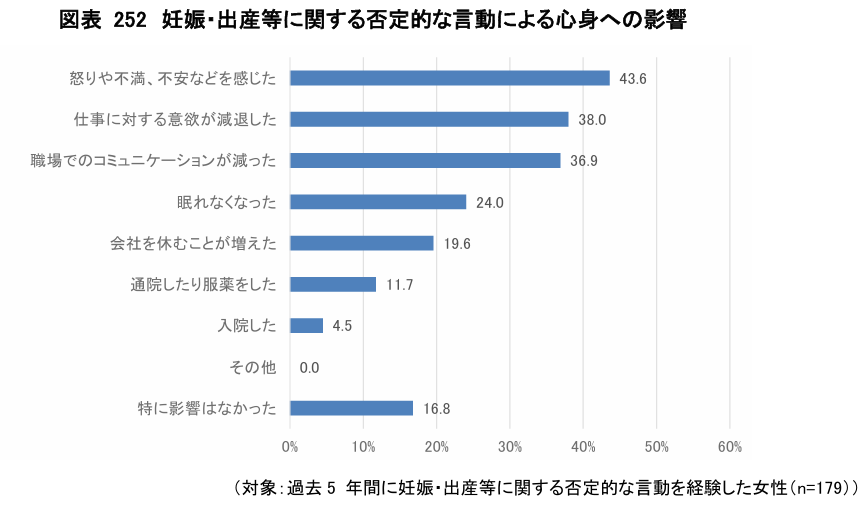
Ministry of Health, Labour and Welfare "Survey on the Actual Conditions of Workplace Harassment"
2023 Edition Report p.214 Table 252
It is a significant risk for companies when their valuable asset, employees, suffer from health issues, which in turn disrupts business operations. Therefore, it is important for the entire organization to acquire correct knowledge about maternity harassment and to engage in conscious behavior on a daily basis.
Therefore, we recommend conducting training on maternity harassment. Implementing such training not only helps in acquiring knowledge and ensuring strict compliance with laws and regulations but also offers various benefits such as improving employee health and motivation, and promoting the active participation of female employees. Additionally, it is expected to serve as an effective preventive measure, especially for managers who are more likely to become perpetrators.
● Benefits Expected from Training on Maternity Harassment
〈Benefit 1〉Improvement of Employee Awareness
Through training, employees gain a deeper understanding of what kinds of actions and remarks constitute maternity harassment, as well as its seriousness and impact. They also learn the importance of extending understanding and support to victims.
〈Merit.2〉Improvement of Work Environment and Communication
By being aware of maternity harassment, it serves as an opportunity to review the existing work environment and communication among employees. As a result, it is expected to increase employee motivation and productivity, reduce turnover rates, and improve employee satisfaction.
〈Merit.3〉Promotion of Female Employees' Success
Preventing maternity harassment supports the success of female employees. By creating a long-term, safe working environment, it leads to career development and the demonstration of leadership among female employees.
〈Merit.4〉Risk Reduction
When maternity harassment occurs, companies may be exposed to legal risks. By preventing maternity harassment in advance through training, such risks can be reduced.
In this way, training on maternity harassment can have positive effects for both companies and employees.
6. Summary

Pregnancy and childbirth are significant life events that can be joyful for those involved, but they can also trigger changes in work patterns. In such cases, if those around have an understanding and knowledge of pregnancy and childbirth, it is expected that maternity harassment can be prevented and a healthy workplace environment can be established.
Therefore, we have conveyed that conducting training on maternity harassment is effective. Especially, training utilizing e-learning offers high convenience and efficiency, allowing learning regardless of time or place.
At Human Science, we offer the e-learning material "STOP! Maternity Harassment ~For Creating a Comfortable Workplace~" that allows easy learning about maternity harassment. In addition to basic knowledge of maternity harassment, it provides clear explanations of various systems related to pregnancy and childbirth. Furthermore, it includes practical information such as consultation contacts for when one experiences or witnesses maternity harassment.
For more details, please refer to the e-learning site of Human Science Co., Ltd.
>Related Site: e-Learning Material "STOP! Matahara ~Creating a Comfortable Workplace~"
Supervisor Information