







2025.12.18
What is an LMS that Solves Educational Challenges in Medical Institutions? Benefits of Implementation and Selection Points
-
Category
Recommended Articles
-
What is Vyond? Introducing the benefits of an animation video production tool that can be used for business.
-
[Animation Teaching Material Production] How to Create e-Learning Materials ②
-
How does Vyond differ from other animation production software? Comparison and recommendations
-
Can Vyond animations be used as teaching materials? Here are the benefits of using them in e-learning and training.
-
Let's create business animations with Vyond! An explanation of the reasons and benefits recommended for business, as well as challenges.
-
Vyond Go (AI Video Generation) Tips and Best Practices ① Vyond Go Setup Guidelines
-
Moodle Basic Course: What is Moodle?
-
[Moodle Basic Course] What can the e-learning management system Moodle do?
-
[Moodle Basic Course] What can be done with Moodle's default features
-
Benefits and Considerations of Moodle Cloud Services
-
Moodle is not only used by universities (widespread use)


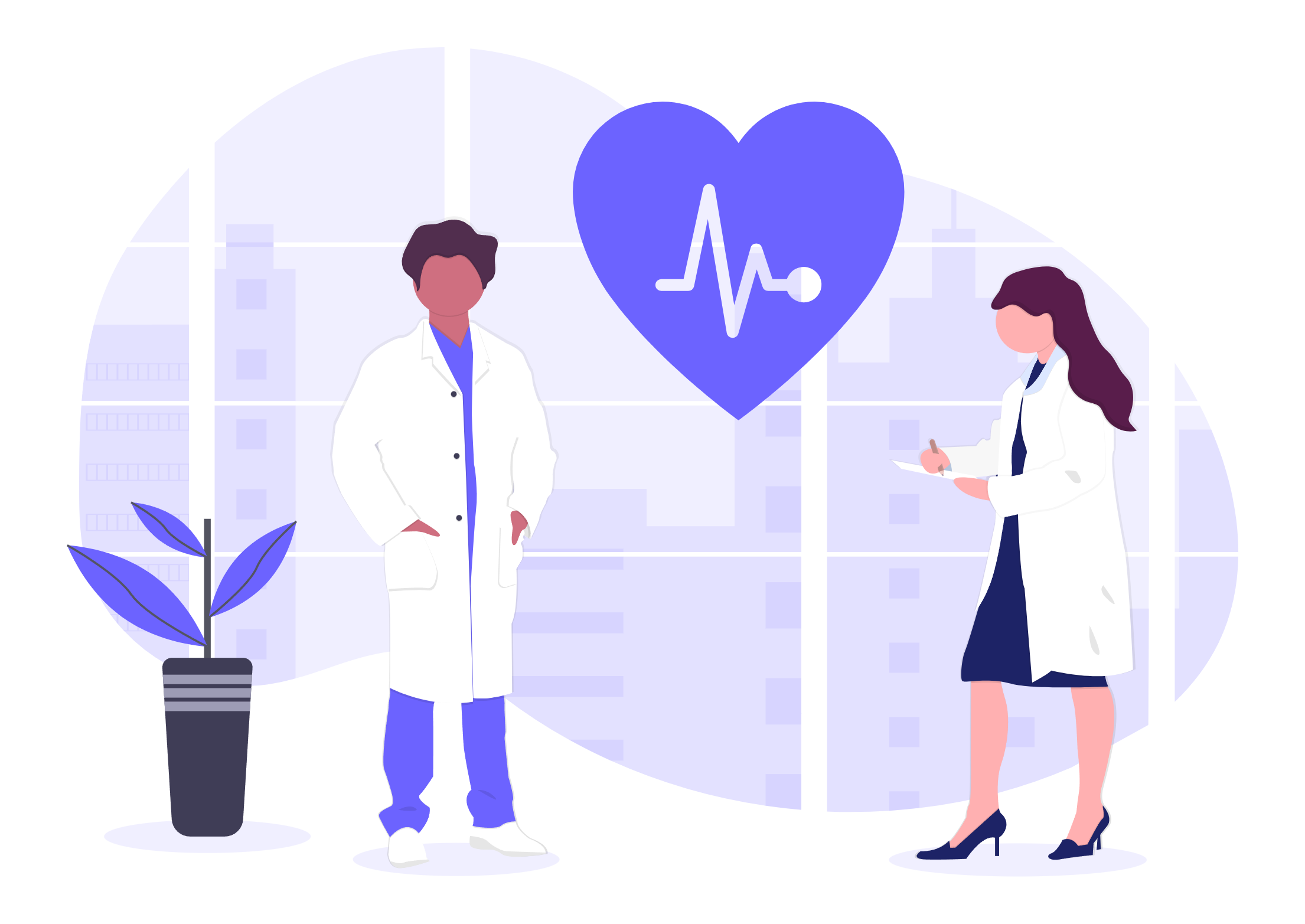
In medical institutions, a system for staff to engage in continuous learning is essential to maintain the quality and safety of medical care. However, many education coordinators may face challenges such as "being too busy to find time for training," "different educational needs depending on the profession," and "difficulty managing training attendance."
In medical institutions with multiple professions, standardizing education and maintaining continuous operation is difficult, and with the requirement to conduct and manage training records based on laws and regulations, traditional methods alone have their limitations.
To address these challenges, the introduction of an LMS (Learning Management System) can be an effective means for improving educational efficiency, centralized record management, and visualizing skills. This article explains the challenges of educational operations in medical institutions, the benefits of introducing an LMS, and key points for selection.
Table of Contents
- 1. The Importance and Challenges of Staff Education in Medical Institutions
- 2. What is an LMS? Benefits of Introducing it in Medical Institutions 2-1. Benefit 1: Reduction of Effort and Increased Efficiency
- 3. Key Points for Selecting the Optimal LMS for Medical Institutions 3-1. Four Requirements for LMS in Medical Institutions
- 4. What is the Recommended LMS 'Totara' for Medical Institutions? Features and Strengths Explained 4-1. Automatic Curriculum Assignment via Dynamic Audiences
- 5. LMS "Totara" Use Cases in the Medical Field 5-1. Mozarc Medical – Enhancing Skill Visualization and Career Support
- 6. Summary|Solving Educational Challenges in Medical Institutions with LMS
2-2. Benefit 2: Automatic Management of Records such as Course History
2-3. Benefit 3: Sustained Motivation and Visualization of Skills
4-2. Secure Design Meeting the Strict Compliance Standards of Medical Institutions
4-3. Visualizing Skills for Reliable Development and Career Support
5-2. Hull University Teaching Hospitals NHS Trust – Streamlining Skill Visualization and Development
1. The Importance and Challenges of Staff Education in Medical Institutions

In medical institutions, professionals such as doctors, nurses, pharmacists, and clinical laboratory technicians are required to possess advanced knowledge and skills according to their respective roles and to consistently provide high-quality medical services. Therefore, it is essential to establish a system where each staff member continuously learns and keeps their skills up to date.
Furthermore, there are many topics that all staff members must commonly understand, such as infection control, prevention of medical accidents, protection of personal information, and compliance. These are not merely internal rules but are positioned as "educational requirements" that medical institutions must plan and implement continuously in accordance with laws and regulations.
However, in the field, shift work and busy duties are routine, making it difficult to consistently provide uniform education to all staff members. It is challenging to secure time for group training, the burden on education coordinators tends to concentrate, and there are cases where the implementation status and effectiveness of training cannot be fully grasped.
Within limited time and personnel, there are limits to balancing education that complies with legal requirements and skill development for staff using only traditional training methods. As a means to address these challenges, the introduction of an LMS is effective. By utilizing an LMS, it is possible to create an environment where staff can receive the necessary education at their own pace during breaks or free time between tasks.
2. What is an LMS? Benefits of Introducing it in Medical Institutions
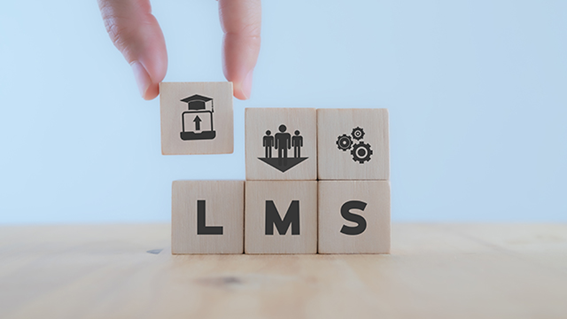
LMS (Learning Management System) refers to a system that centrally manages the distribution of educational content online, progress tracking, and recording of course completion history. It is widely used in companies and educational institutions and is also utilized in medical institutions as a tool to support staff education and career development.
>What kind of LMS is Totara Learn? Introduction to Features and Use Cases
What advantages can be gained by introducing an LMS in medical institutions? Here, we will take a closer look at the specific benefits.
2-1. Benefit 1: Reduction of effort and increased efficiency
In medical institutions, due to outpatient care, night shifts, and shift work, it is difficult to gather all staff at once for training. Traditional group training requires conducting the same content multiple times, which places a heavy burden on education coordinators and instructors.
By introducing an LMS, staff can study at their convenience, regardless of location. Since it can be accessed from smartphones and tablets, learning during breaks, downtime, or commuting time is also possible. This reduces the number of training sessions while providing uniform education to everyone, significantly easing the workload of those in charge of training.
2-2. Benefit 2: Automatic Management of Attendance Records and Other Logs
In medical institutions, it is mandatory to conduct training and manage records based on laws and industry standards, such as infection control and medical safety. Accurately recording who attended which training and when they completed it is essential for audits and reporting.
The LMS automatically records learning histories, allowing administrators to monitor progress in real time, which significantly reduces the risk of human errors and missing records. Furthermore, since necessary data can be easily searched and extracted, report creation and responses to external audits can be handled smoothly.
2-3. Benefit 3: Sustaining Motivation and Visualizing Skills
In medical institution education, in addition to acquiring basic knowledge, there is also a demand for learning that enhances specialization. The LMS has a feature that automatically issues badges and certificates to those who complete training, making it possible to visualize learning achievements.
This not only boosts staff motivation but also enables the entire organization to grasp who has acquired which skills. By visualizing the status of human resource development, it also helps in appropriate personnel placement and the formulation of development plans.
In medical settings, it is required to balance the quality and efficiency of education within limited time and personnel. LMS can be considered an important tool that supports the educational system of medical institutions as an effective means to address these challenges.
3. Key Points for Selecting the Optimal LMS for Medical Institutions
Staff education in medical institutions is a critical task directly linked to improving the quality of medical care, ensuring legal compliance, obtaining certifications, and securing patient safety. In such a complex environment, the functions required of an LMS go beyond mere content delivery and must include the flexibility and management capabilities to meet the unique requirements of medical institutions.
3-1. Four Important Conditions When Selecting
From here, let's look at the conditions for the optimal LMS for medical institutions.
・Condition 1: Flexible learning environment regardless of time and place
Since healthcare workers often have difficulty attending group training due to shift work and emergency responses, one requirement for an LMS is compatibility with various devices such as PCs, smartphones, and tablets. By supporting multiple devices, it provides an environment accessible both inside and outside the facility, ensuring learning opportunities even during work breaks. This enables learning during commuting or rest times, allowing education to continue while reducing the burden on staff.
・Condition 2: Automatic Assignment of Training According to Job Type and Position
The organizational structure of medical institutions is complex, with different training content required for each job type such as doctors, nurses, pharmacists, and administrative staff. Furthermore, staff belonging to committees such as the Infection Control Committee or Medical Safety Committee require specialized training.
To reduce the workload of administrators, an ideal LMS automatically assigns training based on staff attribute information (job type, position, department, committee, etc.). This prevents omissions in education and errors caused by manual management, enabling the prompt and reliable provision of necessary training to all staff.
・Condition 3: Response to Advanced Security
Due to the nature of medical institutions handling sensitive information such as patient data, a high level of security is required for the LMS as well. When selecting an LMS, features such as robust security design to prevent unauthorized access and the recording of operation logs to prevent tampering are essential.
In addition, infrastructure measures beyond the tool itself, such as communication encryption (HTTPS support) and network configuration security (firewalls, DMZ, etc.), are also indispensable.
Whether the company providing and selling the LMS has a system in place to comply with the medical institution's security policies and legal requirements is also an important factor in the selection process. It is necessary to assess whether a secure environment can be built from both technical and organizational perspectives, including post-implementation configuration support and operational assistance.
・Condition 4: Detailed Reporting Functions and Audit Responsiveness
For trainings required by laws and accreditation standards, such as medical safety training, it is sometimes mandatory to retain records of implementation, making this an important verification item during external audits and third-party evaluations. Against this backdrop, an LMS must have flexible and highly reliable reporting functions that can extract and output data such as course attendance history, completion status, certificates, and lists of non-attendees in real time.
4. What is the Recommended LMS 'Totara' for Medical Institutions? Features and Strengths Explained
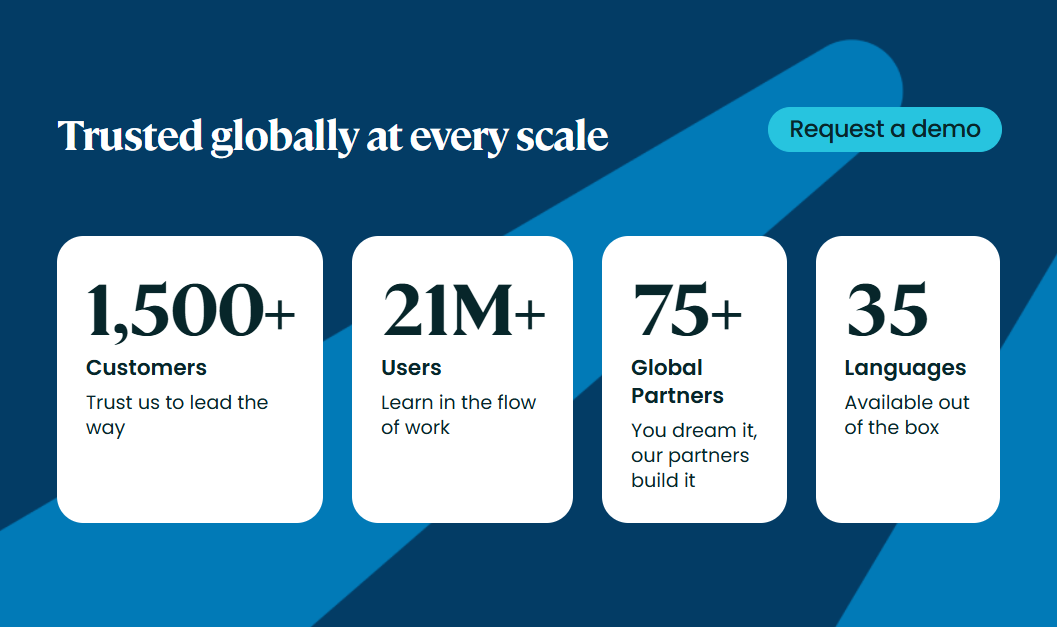
One of the LMSs suitable for medical institutions is Totara, which was developed based on Moodle, widely used by educational institutions worldwide. Totara is an open-source LMS that supports human resource development for companies, medical institutions, educational institutions, and more, and is used by over 1,500 organizations and more than 2.1 million users worldwide (as of October 2025).
It has also been selected as one of the "Top Learning Management System (LMS) Companies," and with a proven track record of implementation across diverse industries such as healthcare, manufacturing, finance, and education, it can be said to be an LMS suitable for medical institutions that require complex organizational structures and legal compliance.
From here, let's take a look at the specific features of Totara.
4-1. Automatic Curriculum Assignment by Dynamic Audience
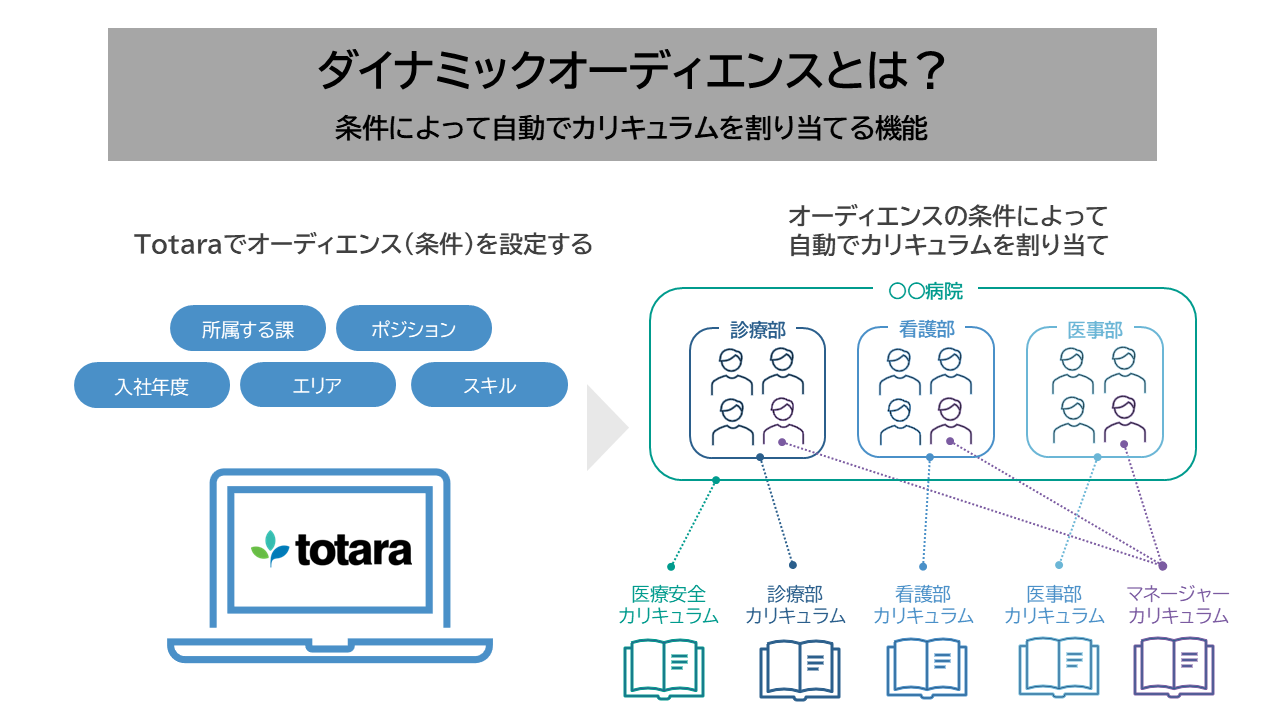
One of Totara's key features is the "Dynamic Audience." Dynamic Audience is a system that automatically assigns the necessary training content based on user attributes and status such as department, position, year of joining, and course completion.
By linking with HR data and setting it up accordingly, for example, when an employee is promoted from staff to manager, the manager-specific curriculum is automatically assigned without any administrator intervention. In medical institutions, various professions such as clinical departments, nursing departments, and medical affairs departments coexist, and the required training differs by profession. However, by utilizing Dynamic Audience, training omissions and manual errors can be prevented, ensuring that all staff receive the necessary education reliably.
Diagram of Totara's Dynamic Audience
4-2. Reliable Design Meeting the Strict Compliance Standards of Medical Institutions
Totara is an LMS that meets the advanced security requirements demanded by medical institutions, continuously improving its design and strengthening security through regular version updates. With one major release per year, each version is guaranteed a support period of at least four years, enabling stable operation.
Additionally, it adopts a design compliant with GDPR (EU General Data Protection Regulation) and can also comply with Japan’s Personal Information Protection Law. This enables medical institutions to achieve both a high level of information protection and legal compliance.
4-3. Visualizing Skills for Reliable Development and Career Support
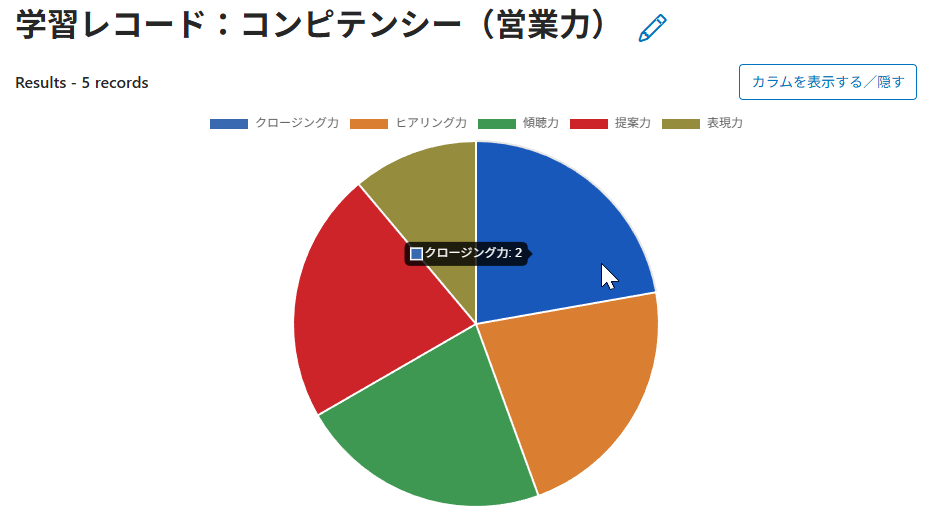
Totara enables visualization of staff skills and training history, allowing you to see at a glance who has reached what level for each job-specific skill set. This clarifies the priorities for development and the direction of career support, making it easier for managers to identify skill gaps among their subordinates. Staff members themselves can also understand the skills and training they need, which leads to increased motivation for growth. In medical settings where multiple professions collaborate, such visualization of skills contributes to improving the overall quality of the organization and enhancing engagement.
Totara Competency Screen
5. LMS "Totara" Use Cases in the Medical Field
From here, we will introduce case studies of Totara implementation in the healthcare industry.
5-1. Mozarc Medical | Automating Training Operations and Significantly Reducing Managerial Burden
Mozarc Medical, a U.S. medical device manufacturer, introduced Totara with the aim of employee skill development and career support. The previous system involved manual and complicated assignment and progress management of training, often causing missed opportunities for timely development and placing a heavy burden on managers.
After implementing Totara, training can be automatically assigned based on skill requirements for each job category, and progress status can be checked at a glance on the dashboard. Managers can grasp skill gaps among their subordinates and propose appropriate training. Employees themselves can visualize their skills and career paths, enabling them to clearly envision their growth direction.
>Link (English):
https://www.totara.com/customer-stories/mozarc-medical/
5-2. Hull University Teaching Hospitals NHS Trust | Visualizing Skills and Streamlining Development
At Hull University Teaching Hospitals NHS Trust in the UK, Totara Learn was introduced to improve the quality and efficiency of staff training. The previously used system had limitations in flexibility and functionality compared to the nationally led LMS, making it challenging to operate in a way that met the needs of the field.
Totara is open source and highly customizable. After implementation, it became possible to visualize staff training histories and learning statuses, enabling managers to quickly grasp their team's course completion and training schedules. Additionally, an environment has been established where staff themselves can proceed with their learning while checking their own learning progress.
Furthermore, personnel processes such as annual evaluations can also be centrally managed on the same platform, enabling smooth integration between development and assessment. Totara, which can flexibly accommodate hospital-specific training requirements, is highly valued on-site as a foundation for education and human resource development.
>Link (English):
https://www.totara.com/customer-stories/hull-university-teaching-hospitals-nhs-trust-overcomes-logistical-training/
6. Summary|Solving Educational Challenges in Medical Institutions with LMS
Staff education in medical institutions is a critical task directly linked to the quality of medical care, legal compliance, and patient safety. However, in complex organizational structures spanning multiple professions and locations, group training alone has its limits, making the use of LMS essential for standardizing education and ensuring continuous operation.
Totara is highly regarded by medical institutions both in Japan and abroad as an LMS equipped with a flexible learning environment, automatic training assignments by job type, advanced security, and detailed reporting features.
Human Science is the only official Totara partner in Japan. If you are responsible for solving HR issues with an LMS, please do not hesitate to contact us. We offer proposals that closely address on-site challenges and provide careful support from implementation through operation.
Related Services
>Human Science | Totara Learn Solutions
About the Author