








2026.07.15
What is the Difference Between Problem-Solving Ability and Issue-Resolving Ability? Necessary Situations, Positions That Should Receive Training, and Key Points for Improving Outcomes

-
Category
Recommended Articles
-
[Moodle Manual ③] 2025 Edition | Support Staff Explain How to Set Up and Utilize Forums!
-
[Moodle Manual ②] 2025 Edition|How to Create Quizzes, Setup Procedures, and FAQ Explained by Support Staff!
-
[Moodle Manual ①] 2025 Edition|How to Set Assignments & Tips for Use Explained by Support Staff!
-
What is Vyond? Introducing the benefits of an animation video production tool that can be used for business.
-
[Animation Teaching Material Production] How to Create e-Learning Materials ②
-
How does Vyond differ from other animation production software? Comparison and recommendations
-
Can Vyond animations be used as teaching materials? Here are the benefits of using them in e-learning and training.
-
Let's create business animations with Vyond! An explanation of the reasons and benefits recommended for business, as well as challenges.
-
Vyond Go (AI Video Generation) Tips and Best Practices ① Vyond Go Setup Guidelines
-
Moodle Basic Course: What is Moodle?
-
[Moodle Basic Course] What can the e-learning management system Moodle do?
-
[Moodle Basic Course] What can be done with Moodle's default features
-
Benefits and Considerations of Moodle Cloud Services
-
Moodle is not only used by universities (widespread use)



The terms "problem-solving ability" and "issue-resolution ability" are often heard in business contexts. Both are important business skills and tend to be discussed without clear distinction, but in fact, these two differ in both approach and role.
In this article, we first clarify the definitions and differences between the two, explain the situations in which they are applied, and particularly introduce the positions that should acquire these skills in an easy-to-understand manner. Furthermore, we provide concrete points to enhance the effectiveness of training. We offer practical tips to correctly discern problem-solving ability and issue-resolution ability and to achieve solid results.
Table of Contents
1. Confirming the Definitions of Problem-Solving Skills and Task-Solving Skills!
2. Situations Where Problem-Solving Skills and Task-Solving Skills Are Required
3. Positions and Roles That Should Receive Training in Problem-Solving and Task-Solving Skills
4. Points to Enhance the Effectiveness of In-House Training on Problem-Solving and Task-Solving Skills
5. Summary
1. Confirming the Definitions of Problem-Solving Ability and Issue-Solving Ability!
First, let's organize the definitions of each and understand why these two skills are indispensable for organizations and their importance.
<What is Problem-Solving Ability>
Problem-solving ability refers to the power to eliminate troubles or obstacles that have already occurred "right in front of you." It means the capability to identify the causes of apparent problems such as mistakes, defects, complaints, or workflow disruptions, and to lead them to resolution, including preventing recurrence.
〈What is Problem-Solving Ability?〉
Problem-solving ability is the power to identify the gap between the ideal (future goals) and the current situation, resolve potential future issues, and create the future. It is the capability to discover improvement points that are not immediately visible, formulate necessary measures toward achieving goals, implement them, and connect them to results.
For a company to consistently achieve stable results, both "problem-solving skills" to address immediate troubles and "issue-solving skills" to continuously improve for the future are indispensable.
We will organize why each is important while touching on their respective benefits.
● Benefits Gained from Problem-Solving Skills
・Prevents confusion on-site and stabilizes quality and service levels
・Enables quick decision-making during troubles, minimizing losses and damage to reputation
・Builds a foundation for safely running daily operations (risk tolerance and operational efficiency)
・Makes it easier to train subordinates and juniors
→ Problem-solving skills are essential for smoothly carrying out daily tasks.
● Benefits Gained from Problem-Setting Ability
・Able to identify areas for improvement with a view to the company's future and goals
・Leads to the creation of new businesses and services
・Can promote sustainable growth of the company even in rapidly changing times
・Able to anticipate, understand, and respond to future risks in advance
→ Problem-solving ability is a skill necessary to move the organization forward into the future.
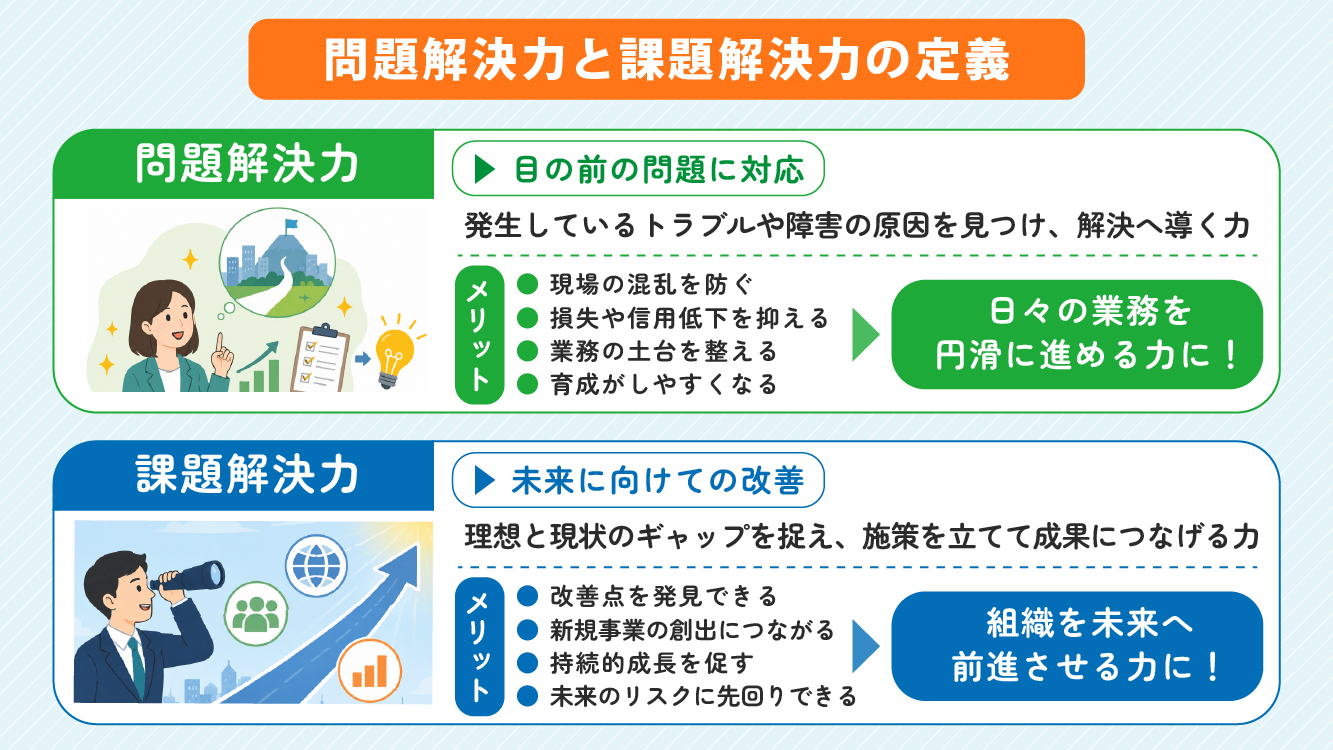
Comparing the benefits of both, problem-solving ability can be described as "the power to stabilize current operations," while task-solving ability is "the power to generate future growth." Without either, a company cannot function well.
Building an internal system resilient to daily troubles while simultaneously creating improvements and new corporate value with a future outlook is the key to achieving long-term growth.
2. Scenes Where Problem-Solving Skills and Issue-Solving Skills Are Required

Problem-solving skills and issue-solving skills differ greatly in the situations where they are needed and the roles they play. In this chapter, we will organize the specific scenes and clarify in what kinds of situations each skill becomes necessary.
〈Scenes Where Problem-Solving Skills Are Required〉
● When Temporary Emergency Response Is Needed
System failures, work delays, unexpected mistakes, and other troubles occurring right before your eyes require speedy and accurate judgment. The role of problem-solving skills is to immediately grasp the situation and take the optimal action on the spot.
● When a complaint arises
This is a "scene that requires immediate response," where it is necessary to quickly lead from understanding the situation to analyzing the cause and proposing measures to prevent recurrence regarding customer service or service deficiencies. The ability to make swift decisions and respond is required to minimize confusion on site.
〈Scenes Where Problem-Solving Skills Are Required〉
● When It Is Necessary to Review the Entire Business Flow
When the cause lies in the system itself, such as "poor work efficiency" or "over-reliance on specific individuals," the ability to identify the gap between the current state and the ideal and to devise improvement measures is required. The mindset of problem-solving skills, focusing not only on the present but also on "how things should be going forward," is important.
● When setting strategies for mid- to long-term goals
Since there are no clear correct answers for sales, productivity, customer satisfaction, and the like, the ability to make decisions by choosing the path expected to lead to the best results is required. Additionally, skills to formulate strategies from a future-oriented perspective, such as "how you want to grow in the mid- to long-term," are necessary.
Problem-solving skills are required in situations where immediate response is needed for troubles occurring on-site, such as system failures or handling complaints. On the other hand, problem-identification skills come into play in scenarios like reviewing business workflows or formulating strategies, where efforts are made with a future-oriented perspective to improve the organization.
As shown, the situations in which each is required differ. By understanding both perspectives, you can achieve a balanced realization of on-site stability and long-term growth.
3. Which Roles and Positions Should Receive Training in Problem-Solving and Issue-Solving Skills?
Both problem-solving and issue-solving skills are useful, but the roles and levels that should prioritize acquiring them differ. Here, we explain the roles and positions where each skill should be particularly strengthened.
◎ Positions/Roles That Should Receive Training in Problem-Solving Skills: Mid-Level and Junior Employees
The employees who most frequently face troubles and unexpected situations on-site are mid-level and junior employees. They play a central role in daily operations and are constantly required to make decisions on the "front lines." Their responses greatly influence the overall workflow. That is why acquiring problem-solving skills that enable quick and accurate judgment leads to strengthening the on-site response capabilities.
〈By acquiring problem-solving skills〉
・Able to accurately grasp the current situation
・Able to logically and swiftly determine the cause
・Able to choose the optimal countermeasure and execute it promptly
Training in problem-solving skills for mid-level and junior employees can be said to be a highly effective investment in preventing operational disruptions.
◎ Positions that should receive training in task-solving skills: Managers and leaders
Task-solving skills are necessary for managers and leaders who are in a position to envision not only the "present" on the front lines but also the "future" of the organization. By possessing this skill, they can oversee the entire workflow and system, indicate directions for improvement, and formulate strategies aimed at medium- to long-term goals. Enhancing the task-solving skills of managerial staff is an effective initiative that significantly supports organizational growth.
〈By Acquiring Problem-Solving Skills〉
・Able to act with foresight
・Can make judgments with a broad perspective and from multiple viewpoints
・Constantly seeks "points for improvement"
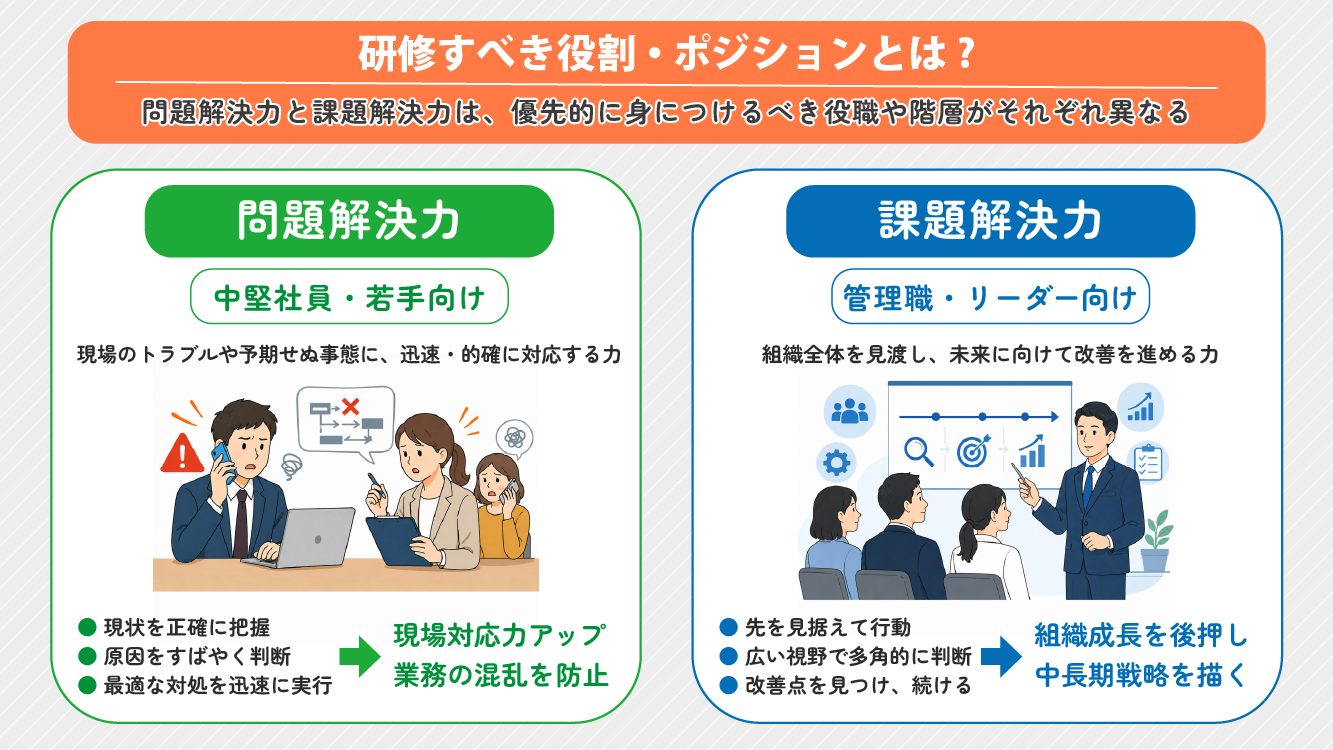
In this way, by clarifying the direction of skill development according to roles and positions, the accuracy of talent development improves, and the personnel necessary for the organization can be steadily nurtured.
4. Key Points to Enhance the Effectiveness of In-House Training on Problem-Solving and Issue-Resolution Skills

Continuous training and practice are essential to acquire problem-solving and issue-resolution skills. Here, we introduce specific methods to enhance the effectiveness of in-house training.
〈Point 1〉Break down necessary skills and provide training
Problem-solving and issue-resolution skills consist of a combination of multiple thinking abilities. For example, organizing causes through logical thinking, eliminating assumptions with critical thinking, and deriving solutions using hypothesis thinking deepen understanding by strengthening each element. Therefore, it is important to break down the skills and learn them step by step.
〈Point.2〉Conduct repetitive practice with e-learning
In training, not only knowledge but also the "amount of practice" affects the results. By utilizing e-learning, individuals can review videos during spare moments and repeatedly engage in case studies at their own pace, making it easier to solidify skills. Furthermore, combining this with face-to-face training allows for effective learning from both input and output perspectives.
〈Point.3〉Create a practical setting with a "Problem-Solving Project"
By setting up projects that tackle problem-solving in actual workplaces, you can directly apply what was learned in training to practice. As a result, a habit of thinking about "how to apply it to our own work" is formed, making the image of skill utilization clearer. Additionally, since results tend to appear in a visible form, an increase in motivation can also be expected.
〈Point.4〉Provide training tailored to each employee's challenges
Problem-solving and issue-resolution skills vary in strengths and weaknesses for each employee. Therefore, instead of uniform training, customizing the training content according to hierarchy, job type, and individual challenges can maximize effectiveness. Furthermore, incorporating individual feedback and coaching helps employees become aware of their own areas for improvement.
By combining these points, training will not end as mere "learning" but will transform into the development of practical skills.
5. Summary

Problem-solving skills that protect the workplace and problem-solving abilities that create the future. For a company to continue growing, it is essential to cultivate the right personnel who support both the "present" and the "future." Enhancing thinking skills through training and daily work practice leads to organizational strength.
To learn the thinking methods that form the foundation of problem-solving and issue-resolution skills, training that strengthens "the power to think itself," such as logical thinking and critical thinking, is effective. Human Science offers e-learning materials that allow you to easily learn these thinking methods.
It is also possible to introduce it together with the world-class e-learning system "Moodle," which can be utilized as a foundation for in-house learning.
For more details, please visit the e-learning site of Human Science Co., Ltd.
>e-Learning Material: "Critical Thinking for Young and Mid-Level Employees"
Supervisor Information