







2026.06.24
How e-Learning Production Companies Use AI — The Reality of Contracted Sites in 2026
② AI Utilization by Educational Theme

-
Category
Recommended Articles
-
What is Vyond? Introducing the benefits of an animation video production tool that can be used for business.
-
[Animation Teaching Material Production] How to Create e-Learning Materials ②
-
How does Vyond differ from other animation production software? Comparison and recommendations
-
Can Vyond animations be used as teaching materials? Here are the benefits of using them in e-learning and training.
-
Let's create business animations with Vyond! An explanation of the reasons and benefits recommended for business, as well as challenges.
-
Vyond Go (AI Video Generation) Tips and Best Practices ① Vyond Go Setup Guidelines
-
Moodle Basic Course: What is Moodle?
-
[Moodle Basic Course] What can the e-learning management system Moodle do?
-
[Moodle Basic Course] What can be done with Moodle's default features
-
Benefits and Considerations of Moodle Cloud Services
-
Moodle is not only used by universities (widespread use)


In the previous article (How e-learning production companies are using AI — The 2026 reality of commissioned projects: ① Degree of AI utilization in the production process), we examined the affinity of AI for each of the following 10 processes.
■The 10 processes of e-learning production
① Needs analysis and target setting ② Learning objective design ③ Content structure design
④ Scenario and script writing ⑤ Visual and diagram production ⑥ Audio and narration production
⑦ Video production and editing ⑧ Question and test design ⑨ LMS implementation and distribution ⑩ Effect measurement and improvement
Although the opportunities to utilize AI are increasing daily, the current situation (as of June 2026) is that we cannot rely entirely on AI to enhance effectiveness.
Table of Contents
- 1. HS Case Study: AI Utilization Ratio by Process in Contracted Projects
- Trends by Project Type (Compliance / Skill Transfer / Knowledge Acquisition)
- ① Product and Service Training, Skill Transfer: Training centered on company-specific information
- ② Store Customer Service, DX Training: Training that mixes general knowledge and company-specific circumstances
- ③ Hierarchical Training, Information Security, Business Skills, Harassment, DE&I: Training centered on general knowledge
- 2. How AI and Humans Interact in the Production of Educational Content Such as e-Learning (Summary of ②)
1. HS Case Study: AI Utilization Ratio by Process in Contracted Projects
Beyond the perspectives introduced last time, the extent to which AI can be used in e-learning production varies. For example, it depends on how well the knowledge to be taught is organized, how much company-specific information is included, and whether learners are expected not only to understand but also to change their behavior.
Here, we broadly divide the educational content into three categories and organize the actual state of AI utilization in contracted sites.
Trends by Project Type (Compliance / Skill Transfer / Knowledge Acquisition)
We categorize the projects our company has handled since 2025 into three types and share the AI utilization ratio by process and the resulting image of changes in production man-hours.
① Product and Service Training, Skill Transfer: Training centered on company-specific information
Education that deals with company-specific knowledge and know-how is the most challenging area for AI utilization.
How to share internal knowledge and technology cannot be sufficiently generated using only the general information that AI has learned. It is realistic to proceed with many processes manually while utilizing AI in some auxiliary processes.
For example, we are commissioned to create product education content for overseas distributors on behalf of Hitachi Construction Machinery.

Reference: Case Study for Hitachi Construction Machinery
In such cases, documented information is often limited or not sufficiently organized in the first place. Many areas rely heavily on the knowledge and experience of instructors and on-site personnel, so it is necessary to first extract information through interviews and then reorganize the dispersed materials into educational content.
Furthermore, it is necessary to take into account company-specific terminology, product characteristics, and on-site precautions unique to the field. Additionally, it is essential to identify who the target audience is and determine which types of expressions (such as diagrams, illustrations, animations, interactions, etc.) are easiest for them to understand, designing through repeated practice and review.
In this area, AI is effective for assisting with material creation and information organization, but human involvement is indispensable in the core processes of educational design.
・Organizing and summarizing dispersed documents and information, facilitating understanding among stakeholders
・Creating materials (images, audio, etc.)
・Generating draft quiz questions, etc.
Also, because this area relies heavily on manual work, production costs tend to rise easily.
On the other hand, when there are many types of products or a large number of skills to be passed down, it can be more effective to establish a system within the company to accumulate and share knowledge rather than creating content each time.
It is necessary to consider multiple options, including not only the utilization of AI but also the introduction of knowledge-sharing systems, the development of shared templates, and the design of operational rules.
② Store Customer Service, DX Training: Training that mixes general knowledge and company-specific circumstances
In this area, while there is general knowledge in the foundational parts, the business workflows and system operations actually used on-site contain a lot of company-specific information.
Therefore, although AI is somewhat easier to utilize than in ①, the final quality still depends on human judgment.
For example, for a major construction company, we create manuals and animated videos as part of internal DX initiatives to convey the benefits of DX and the actual procedures to the on-site staff.

In such cases, the implemented systems and operational rules themselves are highly unique, making it difficult for AI alone to properly organize how to use them.
In our company, especially when dealing with operational procedures, technical writers determine where learners are likely to get confused and translate that into manuals and video expressions.
Also, regarding business workflows, even if the differences between the current paper-based operations and the post-system implementation operations have been organized, a lot of ingenuity is required in how to communicate this and how to ensure it permeates the workplace. Expression and implementation design such as animating the content and combining multiple educational measures are also important.
AI is effective at generating draft plans for structure and expression ideas.
On the other hand, the task of deciding how to actually use these and shaping them into a form that is understandable to learners still primarily relies on human roles.
・Generation of content structure and expression ideas
・Creation of materials (images, audio, etc.)
・Draft generation of quiz questions, etc.
③ Hierarchical Training, Information Security, Business Skills, Harassment, DE&I: Training centered on general knowledge
*However, when dealing with company-specific cases or decision criteria, it approaches ② or ①.
This area is the easiest type of education to utilize AI among the three.
Since the foundational knowledge and general explanatory frameworks are somewhat common, by conveying specific objectives and target audience profiles to AI, it can create drafts for many processes.
However, while AI excels at quickly presenting generalized safe expressions and standard structures, it cannot automatically produce content that deeply fits the learner's situation or designs that lead to behavioral change.
Even in education that conveys generic information, the educational content and expression methods vary greatly depending on the target's situation, the reason for conducting the education, and the goals for what should happen after completion.
It is true that many processes can be entrusted to AI, but verifying the accuracy of the content, adjusting expressions to suit the target audience, and ensuring consistency with learning objectives need to be handled by humans.
We have truly received consultations from many clients in this field, including IT companies, insurance companies, and education and training companies. Since much of the education is based on differences in where the emphasis is placed within general information, we believe that utilizing AI is the most effective approach.
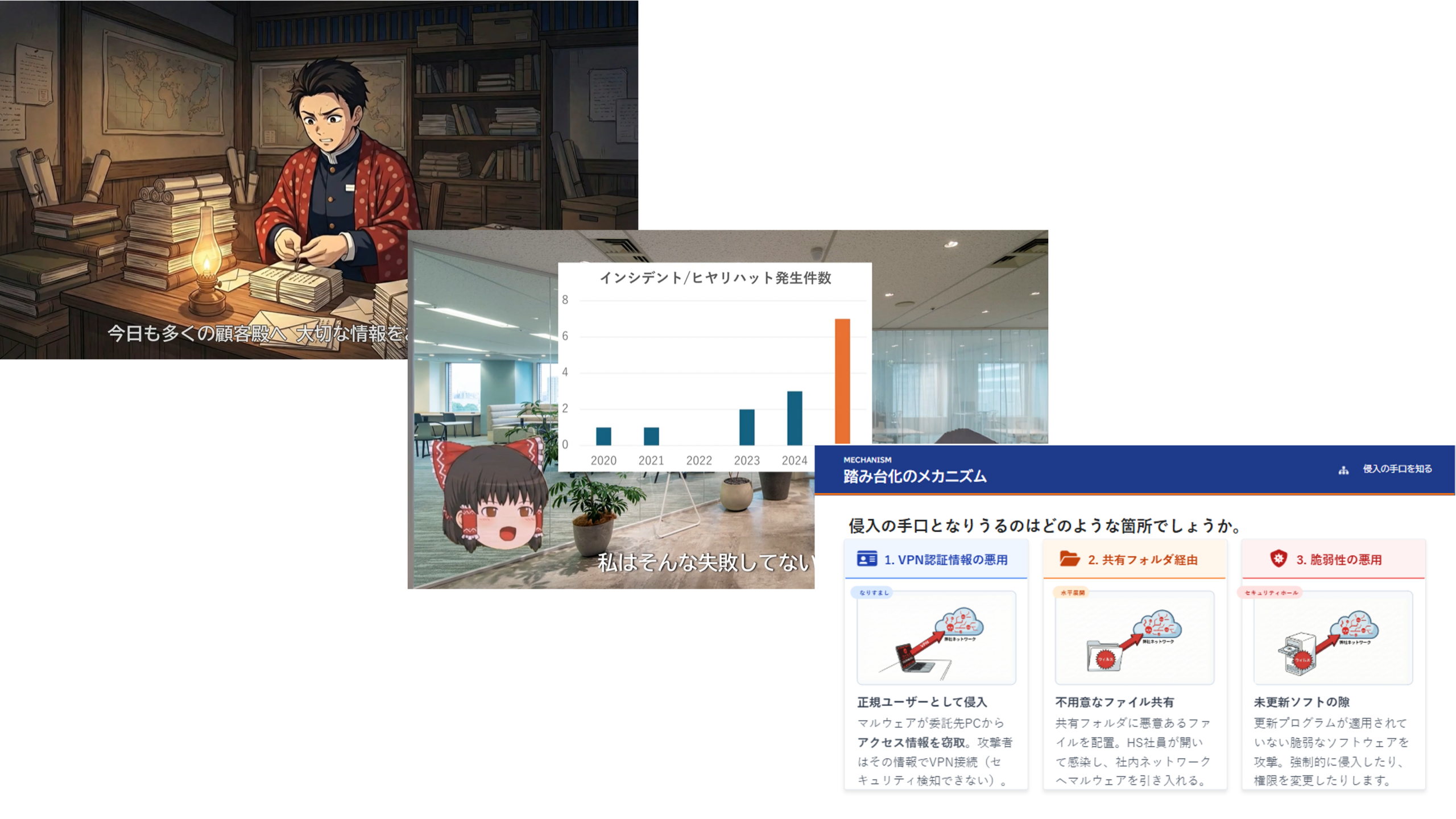
For example, adding case studies tailored to your company's operations or actual cases that occurred within your company can enhance the educational effect. It is also possible to utilize AI to create dialogue for animations and generate videos from that dialogue using tools like Vyond.
However, it is not recommended to use AI-generated scripts as they are.
There is a possibility of hallucinations being included, and the phrasing may be unnatural and difficult to understand. Especially regarding the structure plan, we believe that people should carefully consider the flow and the expressions to be used.
Reference: VyondGo, which can automatically generate animations
・Drafting manuscript proposals
・Creating rough drafts of case studies and examples (fact-checking required)
・Creating materials (images, audio, etc.)
・Drafting quiz questions, etc.
Also, when it is sufficient to add just a little of your company's unique supplementary information to general information, not only creating new content using AI but also adding your own information before and after existing sales content is an effective method.
With this method, it becomes easier to secure a certain level of educational effectiveness while keeping costs down.
2. How AI and Humans Interact in the Production of Educational Content Such as e-Learning (Summary of ②)
As we have seen so far, the ease of utilizing AI in educational content creation varies greatly depending on the nature of the educational material. In particular, the division of roles between humans and AI changes depending on whether there is a lot of company-specific knowledge, whether the knowledge is well-organized, and whether the goal is not only understanding but also behavioral change. Additionally, the extent to which the creator has knowledge and experience regarding the education itself and its content also affects the degree of AI utilization. If you are "planning education for the first time," there is great value in using AI as a consultation partner or as a collaborator for creating initial drafts.
However, AI does not automatically create content that precisely addresses the current situation and challenges of your company or organization. After implementation, it is necessary to evaluate participant feedback, the results of comprehension tests, and subsequent changes in awareness and behavior, and reflect these in the next round of training. Through this continuous process of improvement, we ourselves need to develop the ability to think about and execute "what kind of education should be provided." We believe that AI should not be treated as something to depend on, but rather as a partner to work with, understanding its strengths and weaknesses as we engage with it.
The first blog "① Degree of AI Utilization in the Production Process" analyzes the extent of AI utilization in each stage of the production process. Also, the third blog "③ Production Companies and Clients in the AI Era" discusses the relationship between production companies and clients in the AI era.
Related Services
We provide comprehensive support from planning and design to production, including decisions on how extensively to use AI. Please feel free to consult us about e-learning content production.
E-learning Content Production Service (https://hs-learning.jp/service/teaching/)
About the Author